跳转至

Attention and Transformer

约 2596 个字 307 行代码 4 张图片 预计阅读时间 21 分钟

Attention 让模型在生成或编码每个 token 时动态选择相关上下文,解决传统 Seq2Seq 固定上下文向量的信息瓶颈.本节从 Bahdanau Attention 过渡到 Self-Attention 和 Transformer.

推荐材料:Coding a Transformer from scratch on PyTorch

跟随视频的完整代码实现
  1
  2
  3
  4
  5
  6
  7
  8
  9
 10
 11
 12
 13
 14
 15
 16
 17
 18
 19
 20
 21
 22
 23
 24
 25
 26
 27
 28
 29
 30
 31
 32
 33
 34
 35
 36
 37
 38
 39
 40
 41
 42
 43
 44
 45
 46
 47
 48
 49
 50
 51
 52
 53
 54
 55
 56
 57
 58
 59
 60
 61
 62
 63
 64
 65
 66
 67
 68
 69
 70
 71
 72
 73
 74
 75
 76
 77
 78
 79
 80
 81
 82
 83
 84
 85
 86
 87
 88
 89
 90
 91
 92
 93
 94
 95
 96
 97
 98
 99
100
101
102
103
104
105
106
107
108
109
110
111
112
113
114
115
116
117
118
119
120
121
122
123
124
125
126
127
128
129
130
131
132
133
134
135
136
137
138
139
140
141
142
143
144
145
146
147
148
149
150
151
152
153
154
155
156
157
158
159
160
161
162
163
164
165
166
167
168
169
170
171
172
173
174
175
176
177
178
179
180
181
182
183
184
185
186
187
188
189
190
191
192
193
194
195
196
197
198
199
200
201
202
203
204
205
206
207
208
209
210
211
212
213
214
215
216
217
218
219
220
221
222
223
224
225
226
227
228
229
230
231
232
233
234
235
236
237
238
239
240
241
242
243
244
245
246
247
248
249
250
251
252
253
254
255
256
257
258
259
260
261
262
263
264
265
266
267
268
269
270
271
272
273
274
275
276
277
278
279
280
281
282
283
284
285
286
287
288
289
290
291
292
293
294
295
296
297
298
299
300
301
302
303
304
305
306
307
import torch
import torch.nn as nn
import math

class InputEmbeddings(nn.Module):

    def __init__(self, vocab_size: int, d_model: int):
        # each token have shape (d_model)
        super().__init__()
        self.vocab_size = vocab_size
        self.d_model = d_model
        self.embedding = nn.Embedding(vocab_size, d_model)

    def forward(self, x):
        # 乘以 sqrt(d_model) 是为了和 PE 规模大致匹配
        return self.embedding(x) * math.sqrt(self.d_model)

class PositionalEncoding(nn.Module):

    def __init__(self, d_model: int, seq_len: int, dropout: float):
        super().__init__()
        self.d_model = d_model
        self.seq_len = seq_len
        self.dropout = nn.Dropout(dropout)

        # Create a matrix of shape (seq_len, d_model)
        pe = torch.zeros(seq_len, d_model)

        # Create a vector of shape (seq_len, 1)
        position = torch.arange(0, seq_len).unsqueeze(1)
        div_term = torch.exp(torch.arange(0, d_model, 2).float() * (-math.log(10000) / d_model))

        # Apply the sin to even positions and the cos to odd positions
        pe[:, 0::2] = torch.sin(position * div_term)
        pe[:, 1::2] = torch.cos(position * div_term)

        pe = pe.unsqueeze(0) # (1, seq_len, d_model)

        self.register_buffer('pe', pe)

    def forward(self, x):
        # x: (batch, seq_len, d_model)
        # pe[:, :x.shape[1], :]: (1, seq_len of x, d_model) so can add to x
        x = x + (self.pe[:, :x.shape[1], :]).requires_grad_(False)
        return self.dropout(x)

class LayerNormalization(nn.Module):

    def __init__(self, d_model: int, eps: float = 1e-6):
        super().__init__()
        self.eps = eps
        # gamma / beta 都是 d_model 维
        self.gamma = nn.Parameter(torch.ones(d_model)) # Multiplied
        self.beta = nn.Parameter(torch.zeros(d_model)) # Added

    def forward(self, x):

        # LayerNorm 是作用在每个 token 上的
        mean = x.mean(dim=-1, keepdim=True)
        std = x.std(dim=-1, keepdim=True, unbiased=False)
        return self.gamma * (x - mean) / (std + self.eps) + self.beta

class FeedForwardBlock(nn.Module):

    # x --> Linear_1 --> ReLU --> Dropout --> Linear2 

    def __init__(self, d_model: int, d_ff: int, dropout: float):
        super().__init__()
        self.linear_1 = nn.Linear(d_model, d_ff)
        self.dropout = nn.Dropout(dropout)
        self.linear_2 = nn.Linear(d_ff, d_model)

    def forward(self, x):
        return self.linear_2(self.dropout(torch.relu(self.linear_1(x))))

class MultiHeadAttentionBlock(nn.Module):

    def __init__(self, d_model: int, h: int, dropout: float):
        super().__init__()
        self.d_model = d_model
        self.h = h
        self.dropout = nn.Dropout(dropout)

        assert d_model % h == 0, "d_model is not divisible by h"

        self.d_k = d_model // h
        self.w_q = nn.Linear(d_model, d_model) 
        self.w_k = nn.Linear(d_model, d_model) 
        self.w_v = nn.Linear(d_model, d_model) 
        self.w_o = nn.Linear(d_model, d_model)    

    @staticmethod
    def attention(q, k, v, mask, dropout: nn.Dropout):

        # q, k, v: (batch, h, seq_len, d_k)
        d_k = k.shape[-1]

        # (batch, h, seq_len, d_k) --> (batch, h, seq_len, seq_len)
        # 多头注意力的拆分是对每个 token 的拆分,经过线性层后把每个 token 分成 h 份
        attention_scores = q @ k.transpose(-2, -1) / math.sqrt(d_k)

        if mask is not None:
            attention_scores.masked_fill_(mask, -1e9)

        attention_scores = attention_scores.softmax(dim=-1)

        if dropout is not None:
            attention_scores = dropout(attention_scores)

        return attention_scores @ v, attention_scores

    def forward(self, query, key, value, mask):

        # (batch, seq_len, d_model) --> (batch, seq_len, d_model)
        q = self.w_q(query)
        k = self.w_k(key)
        v = self.w_v(value)

        # (batch, seq_len, d_model) --> (batch, seq_len, h, d_k) --> (batch, h, seq_len, d_k)
        # 相当于把 h 个 Q K V 放在同一个张量里了
        q = q.view(q.shape[0], q.shape[1], self.h, self.d_k).transpose(1, 2)
        k = k.view(k.shape[0], k.shape[1], self.h, self.d_k).transpose(1, 2)
        v = v.view(v.shape[0], v.shape[1], self.h, self.d_k).transpose(1, 2)

        x, self.attention_scores = MultiHeadAttentionBlock.attention(q, k, v, mask, self.dropout)

        # (batch, h, seq_len, d_k) --> (batch, seq_len, h, d_k) --> (batch, seq_len, d_model)
        x = x.transpose(1, 2).contiguous().view(x.shape[0], -1, self.d_model)

        # (batch, seq_len, d_model) --> (batch, seq_len, d_model)
        return self.w_o(x)

class ResidualConnection(nn.Module):

    # y = x + dropout(Sublayer(LayerNorm(x)))

    def __init__(self, d_model: int, dropout: float):
        super().__init__()
        self.dropout = nn.Dropout(dropout)
        self.norm = LayerNormalization(d_model)

    def forward(self, x, sublayer):
        return x + self.dropout(sublayer(self.norm(x)))

class EncoderBlock(nn.Module):

    def __init__(self, 
                self_attention_block: MultiHeadAttentionBlock,
                feed_forward_block: FeedForwardBlock,
                d_model: int,
                dropout: float):
        super().__init__()
        self.self_attention_block = self_attention_block
        self.feed_forward_block = feed_forward_block
        self.dropout = nn.Dropout(dropout)
        # 用 ModuleList 把两个残差连接放到一起
        self.residual_connections = nn.ModuleList([ResidualConnection(d_model, dropout) for _ in range(2)])

    def forward(self, x, src_mask):
        # src_mask 通常只屏蔽源句子里的 <pad>,包括 decoder 内的也是屏蔽作用

        # 第一层:此时的 sublayer 为自注意力层,传入接收 x,输出自注意力结果的 lambda 函数
        # 由于继承 nn.Module 类的实例直接用 () 相当于使用 .forward(),因此可以直接将类实例传入
        x = self.residual_connections[0](x, lambda x: self.self_attention_block(x, x, x, src_mask))
        x = self.residual_connections[1](x, self.feed_forward_block)
        return x

class Encoder(nn.Module):

    # layers 的元素都是 EncoderBlock
    def __init__(self, layers: nn.ModuleList, d_model: int):
        super().__init__()
        self.layers = layers
        self.norm = LayerNormalization(d_model)

    def forward(self, x, mask):
        for layer in self.layers:
            x = layer(x, mask)
        return self.norm(x) # pre-norm 每次归一化都在子层之前做的,最后一个 layer 的输出还没有归一化

class DecoderBlock(nn.Module):

    def __init__(self, 
                self_attention_block: MultiHeadAttentionBlock,
                cross_attention_block: MultiHeadAttentionBlock,
                feed_forward_block: FeedForwardBlock,
                d_model: int,
                dropout: float):
        super().__init__()
        self.self_attention_block = self_attention_block
        self.cross_attention_block = cross_attention_block
        self.feed_forward_block = feed_forward_block
        self.dropout = nn.Dropout(dropout)
        self.residual_connections = nn.ModuleList([ResidualConnection(d_model, dropout) for _ in range(3)])

    def forward(self, x, encoder_output, src_mask, tgt_mask):
        # src_mask 用来屏蔽源序列 <pad>,tgt_mask 用来防止 decoder 自注意力偷看未来
        x = self.residual_connections[0](x, lambda x: self.self_attention_block(x, x, x, tgt_mask))
        x = self.residual_connections[1](x, lambda x: self.cross_attention_block(x, encoder_output, encoder_output, src_mask))
        x = self.residual_connections[2](x, self.feed_forward_block)
        return x

class Decoder(nn.Module):

    # layers 的元素都是 DecoderBlock
    def __init__(self, layers: nn.ModuleList, d_model: int):
        super().__init__()
        self.layers = layers
        self.norm = LayerNormalization(d_model)

    def forward(self, x, encoder_output, src_mask, tgt_mask):
        for layer in self.layers:
            x = layer(x, encoder_output, src_mask, tgt_mask)
        return self.norm(x)

class ProjectionLayer(nn.Module):

    def __init__(self, d_model: int, vocab_size: int):
        super().__init__()
        self.proj = nn.Linear(d_model, vocab_size)

    def forward(self, x):
        # (batch, seq_len, d_model) --> (batch, seq_len, vocab_size)
        return torch.log_softmax(self.proj(x), dim=-1)

class Transformer(nn.Module):

    def __init__(self,
                encoder: Encoder,
                decoder: Decoder,
                src_embed: InputEmbeddings,
                tgt_embed: InputEmbeddings,
                src_pos: PositionalEncoding,
                tgt_pos: PositionalEncoding,
                projection_layer: ProjectionLayer):
        super().__init__() 
        self.encoder = encoder
        self.decoder = decoder
        self.src_embed = src_embed
        self.tgt_embed = tgt_embed
        self.src_pos = src_pos
        self.tgt_pos = tgt_pos
        self.projection_layer = projection_layer

    def encode(self, src, src_mask):
        src = self.src_embed(src)
        src = self.src_pos(src)
        return self.encoder(src, src_mask)

    def decode(self, encoder_output, src_mask, tgt, tgt_mask):
        tgt = self.tgt_embed(tgt)
        tgt = self.tgt_pos(tgt)
        return self.decoder(tgt, encoder_output, src_mask, tgt_mask)

    def project(self, x):
        return self.projection_layer(x)

def build_transformer(src_vocab_size: int,
                    tgt_vocab_size: int,
                    src_seq_len: int,
                    tgt_seq_len: int,
                    d_model: int = 512,
                    N: int = 6,
                    h: int = 8,
                    dropout: float = 0.1,
                    d_ff: int = 2048) -> Transformer:
    # Create the embedding layers
    src_embed = InputEmbeddings(src_vocab_size, d_model)
    tgt_embed = InputEmbeddings(tgt_vocab_size, d_model)

    # Create the positional encoding layers
    src_pos = PositionalEncoding(d_model, src_seq_len, dropout)
    tgt_pos = PositionalEncoding(d_model, tgt_seq_len, dropout)

    # Create the encoder blocks
    encoder_blocks = []
    for _ in range(N):
        encoder_self_attention_block = MultiHeadAttentionBlock(d_model, h, dropout)
        feed_forward_block = FeedForwardBlock(d_model, d_ff, dropout)
        encoder_block = EncoderBlock(encoder_self_attention_block, feed_forward_block, d_model, dropout)
        encoder_blocks.append(encoder_block)

    # Create the decoder blocks
    decoder_blocks = []
    for _ in range(N):
        decoder_self_attention_block = MultiHeadAttentionBlock(d_model, h, dropout)
        decoder_cross_attention_block = MultiHeadAttentionBlock(d_model, h, dropout)
        feed_forward_block = FeedForwardBlock(d_model, d_ff, dropout)
        decoder_block = DecoderBlock(decoder_self_attention_block, decoder_cross_attention_block, feed_forward_block, d_model, dropout)
        decoder_blocks.append(decoder_block)

    # Create the encoder and decoder
    encoder = Encoder(nn.ModuleList(encoder_blocks), d_model)
    decoder = Decoder(nn.ModuleList(decoder_blocks), d_model)

    # Create the projection layer
    projection_layer = ProjectionLayer(d_model, tgt_vocab_size)

    # Create the transformer
    transformer = Transformer(encoder, decoder, src_embed, tgt_embed, src_pos, tgt_pos, projection_layer)

    # Initialize the parameters
    for p in transformer.parameters():
        if p.dim() > 1: # 只初始化矩阵,bias 这类一维不初始化
            nn.init.xavier_uniform_(p)

    return transformer

1. Bottleneck in Seq2Seq

在语言建模中提到的 Seq2Seq 模型,有两个问题:

  • 信息压缩:源句越长,越难把所有信息都压进一个固定长度向量里;这个问题在 LSTM、GRU 中仍然存在.
  • 缺少动态性:翻译一句话时,生成不同目标词通常需要关注源句中的不同部分;而传统 seq2seq 中上下文向量是固定的.

按照人类的行为,如果我们来做翻译,会动态地根据前文来判断当前词语的含义.这就引出了注意力的概念.

2. Bahdanau Attention

由于需要动态查看前文,因此不再是看一个固定的上下文向量,而是把所有的隐状态都保留下来.

解码器生成第 \(t\) 个词时,模型会重新查看所有的隐状态,并将隐状态加权求和得到一个特定的上下文向量,这个向量包含了生成这个词需要特别关注的内容.

具体过程:
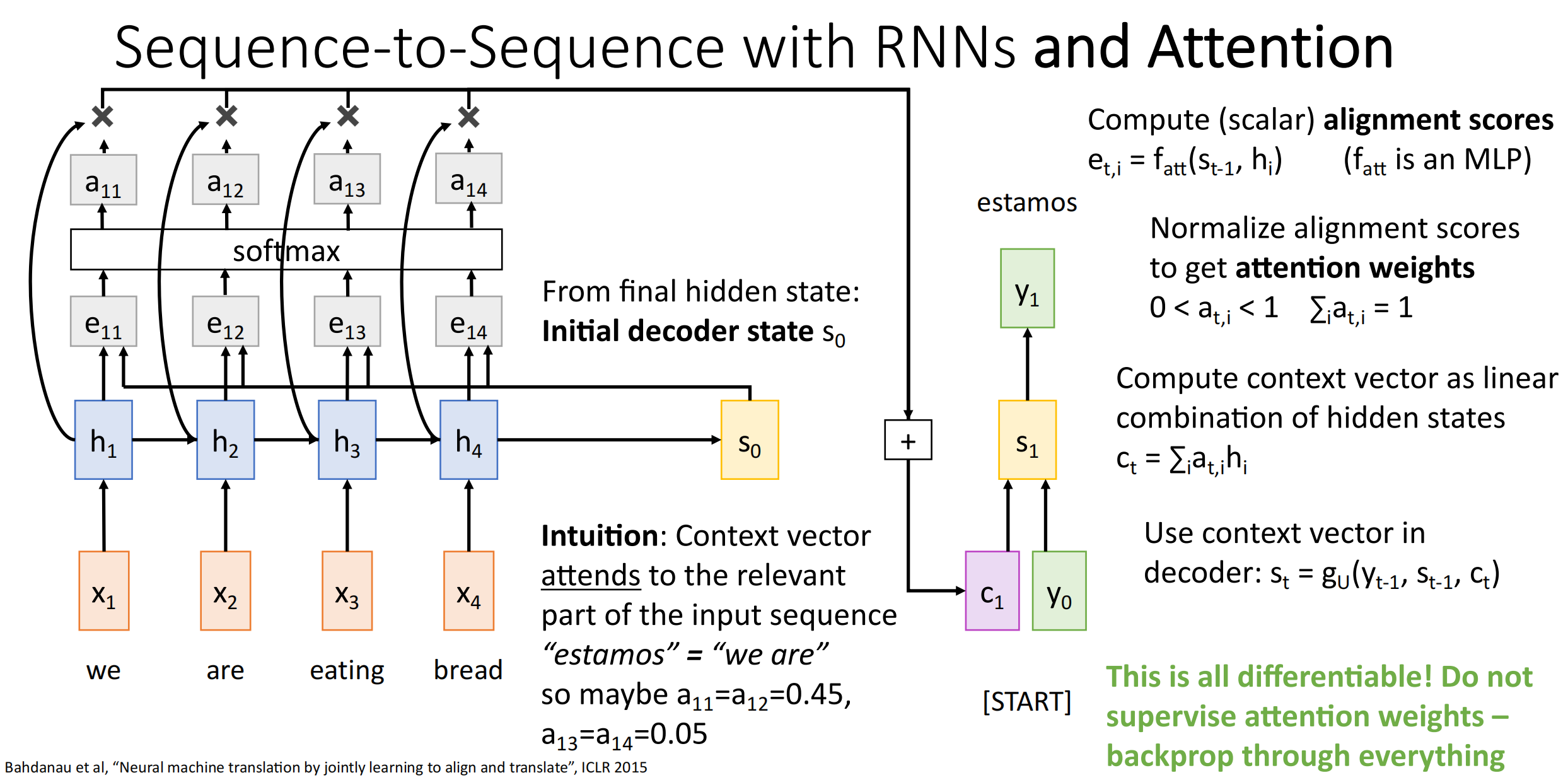
image-20260526081228999
  • 解码器当前状态 \(s_{t-1}\) 和所有隐状态 \(h_i\) 计算得到分数 \(e_{i,t}\).其使用的是一个小型前馈神经网络.
  • 得到了分数后,用 softmax 函数对其进行归一化处理得到注意力权重 \(\alpha_{i,t}\)
  • 再用注意力权重对隐状态进行加权求和,即 \(c_t=\sum\alpha_{t,i}h_i\),得到此时的上下文向量.

可视化

我们用机器翻译的结果,对注意力权重进行可视化:可以发现对应的词语的注意力权重会较高,如英语中的 Area 对应法语中的 zone、European 对应 européenne 等.
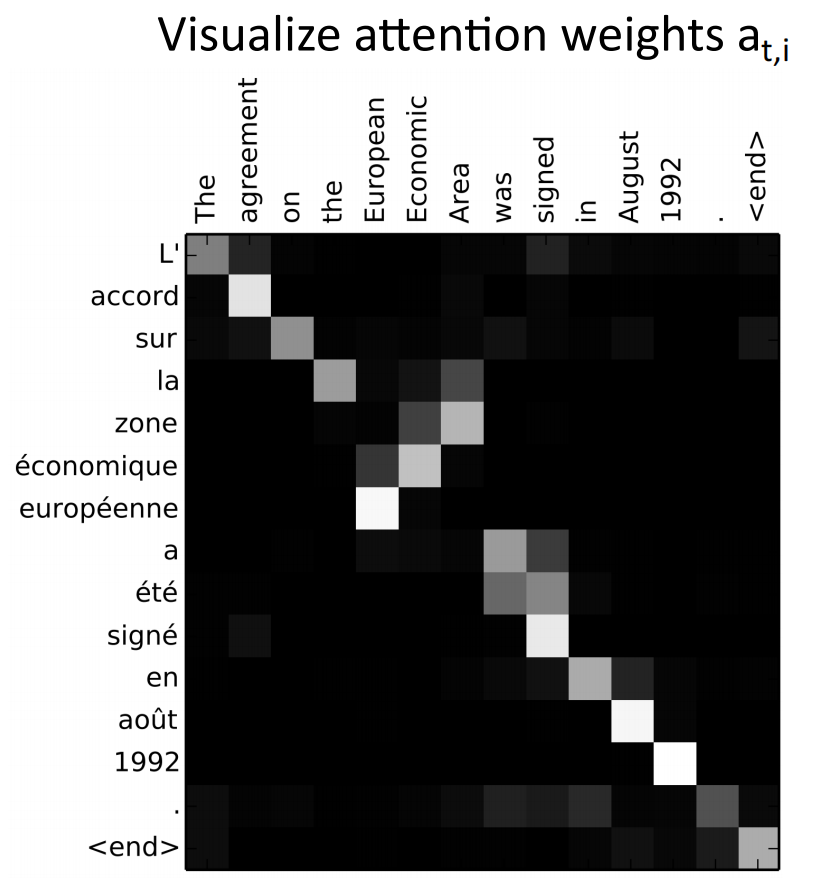
image-20260526082927712

3. Cross-Attention

为了方便计算,我们直接取上文中计算分数的方式为向量点积.这样我们还能用矩阵来进行并行计算.这样就引出了接近现代注意力机制的 Cross-Attention(交叉注意力).

3.1 Query、Key、Value

现代 Attention 通常用 Query、Key、Value 来描述检索过程:

  • Query 表示需求;
  • Key 用来参与匹配;
  • Value 用来提供内容.

与 Bahdanau Attention(用隐状态同时来匹配与输出内容)最大的差别是把 Key 和 Value 分开了.这样的好处是用于匹配的信息和最终取回的信息可以不一致.

例如使用 Google 搜索“世界上最高的山是什么”,参与匹配的 key 是”世界上最高的山”这个问题本身,而“珠穆朗玛峰”才是需要的 value.

3.2 Matrices Form

假设查询序列 \(X\in \mathbb{R}^{N_x\times d}\),被查询序列 \(Y \in \mathbb{R}^{N_y\times d}\).其中 \(N_q、N_y\) 为查询序列的长度,\(d\) 为每个 token 的维度.

投影矩阵 \(W_Q\in \mathbb{R}^{d\times d_k}\)\(W_K\in \mathbb{R}^{d\times d_k}\)\(W_V=\in \mathbb{R}^{d\times d_v}\)(一般取 \(d_v=d_k\)).

首先将查询矩阵与被查询矩阵投影得到 \(Q、K、V\)

  • \(Q=XW_Q\in \mathbb{R}^{N_x\times d_k}\)
  • \(K=YW_K\in \mathbb{R}^{N_y\times d_k}\)
  • \(V=YW_V\in \mathbb{R}^{N_y\times d_v}\)

然后计算 query 和 key 的相似度矩阵 \(S=QK^T\in \mathbb{R}^{N_x\times N_y}\),其表示查询序列对被查询序列的相关性分数.

如果直接做点积运算,\(S\) 中的每一个元素都是 \(d_k\) 对乘积的和.当 \(d_k\) 很大时,点积数值也会变大,导致 softmax 结果十分尖锐(某一位置概率接近 1,其他都接近 0),导致梯度变小等问题.具体而言,如果 \(Q、K\) 元素服从标准正态分布,那么 \(d_k\) 项乘积和方差接近 \(d_k\),因此需要除以标准差 \(\sqrt{d_k}\) 来实现方差归一化.

得到相关性分数后,再用 softmax 对分数进行归一化.接着对 value 进行加权平均,得到的维度为 $ \mathbb{R}^{N_x\times d_v}$,即每一个查询都有对应的注意力分布.

即完整公式为:

\[ \text{Attention}(Q,K,V)=\text{softmax}\left( \frac{QK^T}{\sqrt{d_k}} \right) V \]

注意力机制最后得到的输出是什么?

其输出维度和输入是完全一致的,每一个 token 的词向量表示都是 \(V\) 中词向量的加权组合,可以理解为融合了其他词向量.

4. Self-Attention

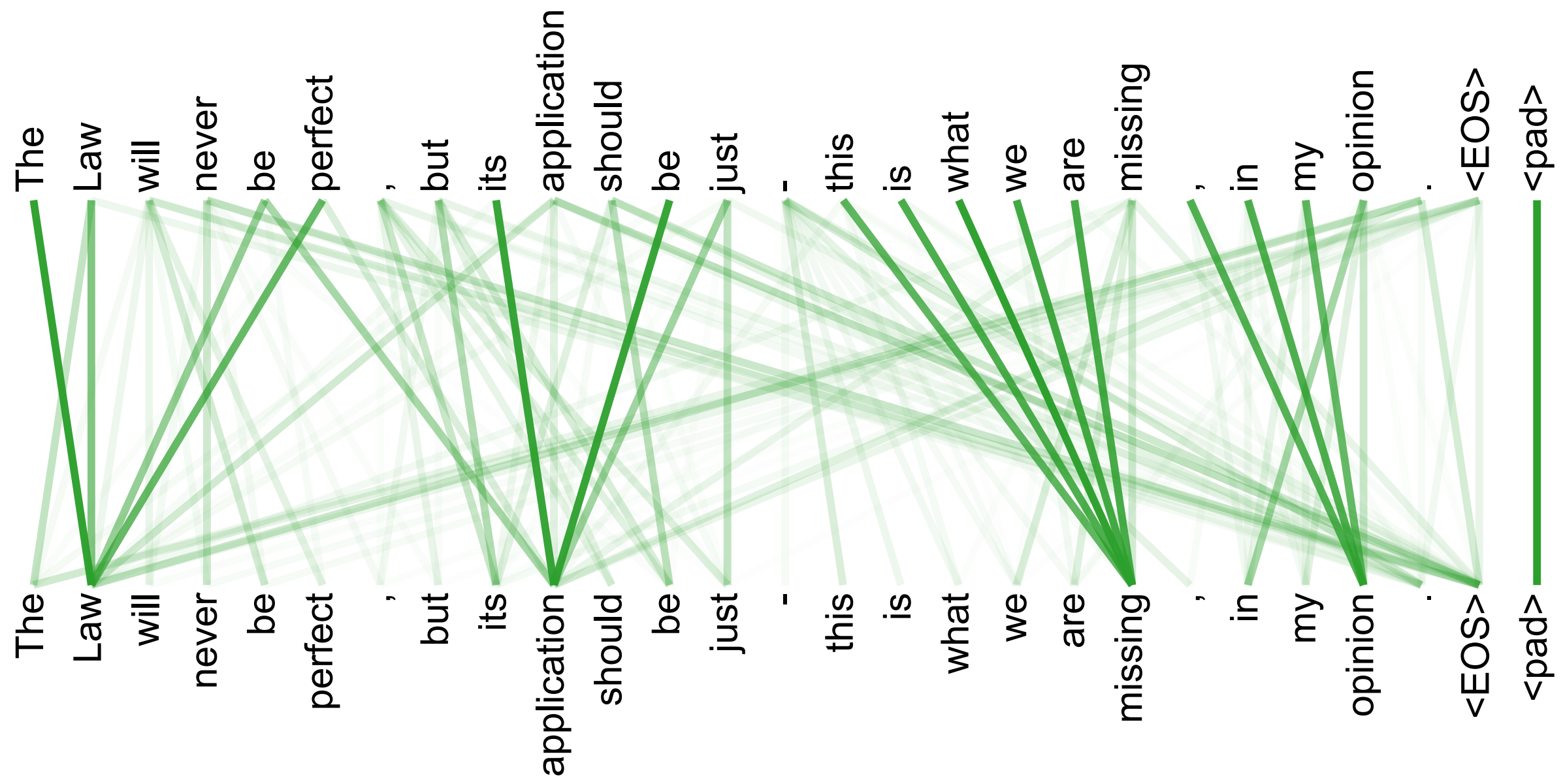
对于一个序列里的 token,其如果想了解上下文并关注自己与其他 token 的相关性,就需要这个序列对自己做一次交叉注意力,即 Self-Attention(自注意力).

自注意力与交叉注意力在形式上的区别就是查询矩阵和被查询矩阵都是 \(X\)

在自注意力中,任意两个 token 可以直接进行交互,信息路径更短,容易建立长距离依赖;并且其主要计算均为矩阵乘法,天生容易并行;因此其天生适合序列建模.
img

但自注意力机制仍然有许多不足,而这些不足将在后续内容中提出解决方案.

5. Positional Encoding

自注意力的问题之一:它不知道 token 之间的顺序,因此不知道顺序带来的影响.

考虑两个 3 token 序列:dog bites manman bites dog.这两个句子包含的词完全一样,但顺序不同,意思也完全不同.而对自注意力来说,两个输入 token 交换了顺序,但它们都是做相同的矩阵乘法,最后的结果也只是输出调换了位置.

最直接的解决方法是给每个位置加上一个 embedding 向量,即 \(z_i=x_i+p_i\),或矩阵形式 \(Z=X+P\).而使用相加而非拼接,好处是不会改变向量维度,可以直接套用原来的模型.

正弦位置编码

在原始 Transformer 论文中,作者采用了固定的正弦位置编码,直接由公式生成;对于位置 \(pos\) 和维度 \(i\),其定义为:

\[ \begin{align*} PE_{(pos, 2i)} &= \sin \left(\frac{pos}{10000^{2i / d_\mathrm{model}}} \right) \\ PE_{(pos, 2i+1)} &= \cos \left(\frac{pos}{10000^{2i / d_\mathrm{model}}} \right) \end{align*} \]

当然,也可以使用可学习的位置编码.

6. Multi-Head Attention

如同 CNN 需要多个卷积核提取多个特征一样,注意力也需要有一种能让一组 token 建立不同联系的方法,如语法、语义.因此 Transformer 论文中提出了 Multi-head Attention(多头注意力).

对于常见的 \(d_k=d_\text{model}=512、h=8\),其做法是 \(W_Q,W_K,W_Q\)\(512 \to 512\) 的线性层让同一个 token 的表示充分融合,然后直接将这 \(512\) 拆分成 \(8\times 64\)(此时 64 即为 \(d_k\)) ,再将 \(h\) 维度与 \(seq\_len\) 维度置换,从而方便使用矩阵进行并行计算.也就是说多个头,其实是在一个张量内部完成的.计算时 \(h\) 是张量的第一维.

最后每一个头得到最后一维是 64 的输出,将它们拼起来再置换,恢复成输入形状.

在 Transformer 中,Cross-Attention 与 Self-Attention 使用的均为 Multi-Head Attention,只是传入作为 Q、K、V 的张量不同.

7. Layer Norm

处理文本时,由于不同序列文本长度不一致,因此 BatchNorm 在批之间归一化的方式并不好用;常使用 Layer Normalization(层归一化).

Layer Norm 是把每个 token 的向量表示进行归一化.即对于 (batch, seq_len, d_model) 的输入,其在 d_model 维度进行归一化.归一化步骤同 BatchNorm:减去均值、除以标准差,再乘以可学习的缩放、加上可学习的偏置(一般维度为 d_model).

8. Transformer

至此,Transformer 架构的基本单元已经集齐.Transformer 架构图:
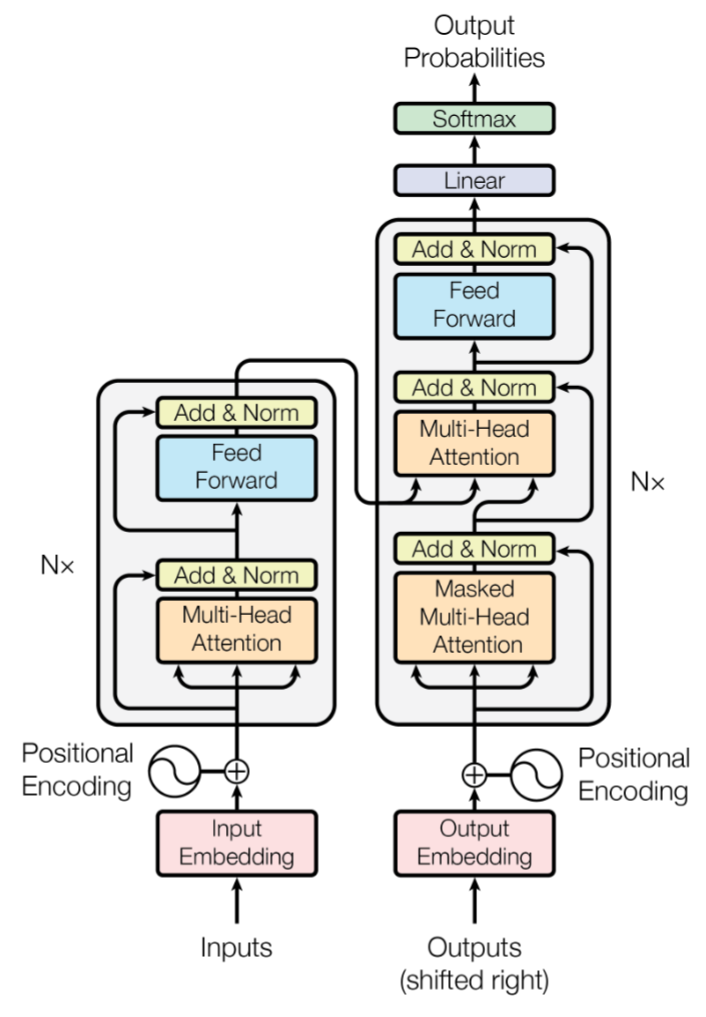
image-20260605123257996

8.1 Encoder Block

根据架构图,输入经过词嵌入后加上位置编码进入 Encoder Block.每个 Encoder Block 包含 Multi-Head Self-Attention 和 Feed-Forward Network 两个模块,每个模块都各自包含 LayerNorm、Dropout 和 Residual Connection.

所以,一个 Encoder Block 可以写成:

\[ H = \operatorname{LayerNorm}(X + \operatorname{MultiheadAttention}(X)) \]
\[ Y = \operatorname{LayerNorm}(H + \operatorname{FFN}(H)) \]

8.1.1 Pre-Norm 与 Post-Norm

原始 Transformer 中将 LayerNorm 放在子模块和残差连接之后,这种称为 Post-Norm.现代 Transformer 实现中,更常见的是 Pre-Norm,将 LayerNorm 放在子模块和残差连接之前:

\[ H = X + \operatorname{MultiheadAttention}(\operatorname{LayerNorm}(X)) \]
\[ Y = H + \operatorname{FFN}(\operatorname{LayerNorm}(H)) \]

具体原因可以参考苏剑林老师的博客:为什么Pre Norm的效果不如Post Norm?

8.2 Decoder Block

Decoder Block 由三个类似模块组成,分别包含 Masked Self Attention、 Cross Attention、Feed Forward Netword,和对应的 Norm 与 Residual.

8.2.1 Masked Self Attention

在训练 Decoder 时,通常会把目标序列右移一位作为输入:

1
2
Decoder input:  <BOS>   y1    y2    y3
Target  label:  y1      y2    y3    <EOS>

训练时采用 Teacher Forcing 方法:训练时的历史 token 来自真实答案而不是模型自己生成的结果.同时一次性输入完整前缀能发挥 Attention 的并行优势.

但是一次性输入完整前缀,模型会偷看未来,因此要加上 Causual Mask,保证自注意力只能注意到自己及之前,即:

1
2
3
4
位置 1 只能看到 BOS
位置 2 只能看到 BOS, y1
位置 3 只能看到 BOS, y1, y2
位置 4 只能看到 BOS, y1, y2, y3

从实现角度,在自注意力计算得到分数后、进入 softmax 之前,将自注意力矩阵不含对角线的右上三角全部设为 \(-\infty\);保证 softmax 后的结果和为 1 的同时防止模型偷看未来.

推理时,模型没有正确答案,每一次生成下一 token 后再进行下一次自注意力串行推理,即自回归生成.

8.2.2 Cross Attention

Encoder 侧处理输入序列后得到源序列的上下文表示 \(H_\text{enc}=\text{Encoder}(X)\);将 \(H_\text{enc}\) 作为 K、V,Decoder 侧输入经过 Masked Self-Attention 后得到的上下文表示作为 Q,进行 Cross-Attention.

8.3 Transformer

根据架构图,将 Encoder / Decoder Block 堆叠 N(一般取 6)次后得到 Encoder / Decoder,再与开始的词嵌入层、位置编码,最后的线性投影层、输出层连接得到完整的 Transformer.