Chap 1: Logic and Proofs
约 6659 个字 35 张图片 预计阅读时间 33 分钟
1. Propositional Logic
1.1 Propositions
proposition(命题): A declarative sentence that is either true or false.
propositional variables(命题变量): Variables that represent propositions, usually letters like \(p,q,r,s\).
atomic proposition(原子命题): Propositions that cannot be expressed by simpler propositions.
compound proposition(复合命题): Propositions that formed from existing propositions using logical operators.
1.2 Logical Operators
1.2.1 Operators
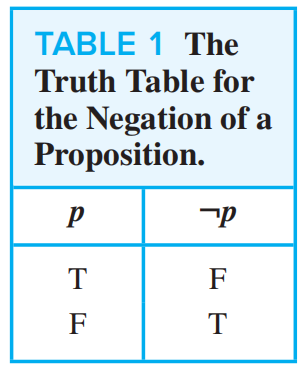
negation(not, 否定): \(\neg p\).
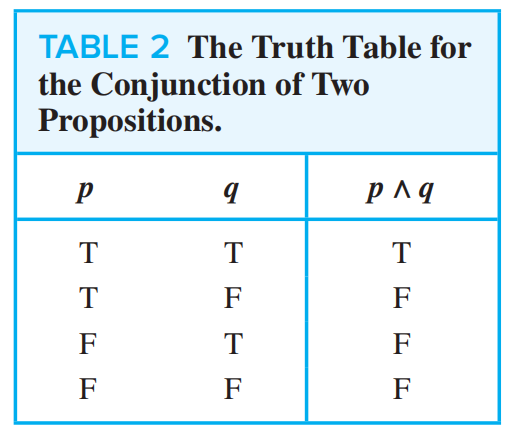
conjunction(and, 合取): \(p\wedge q\).
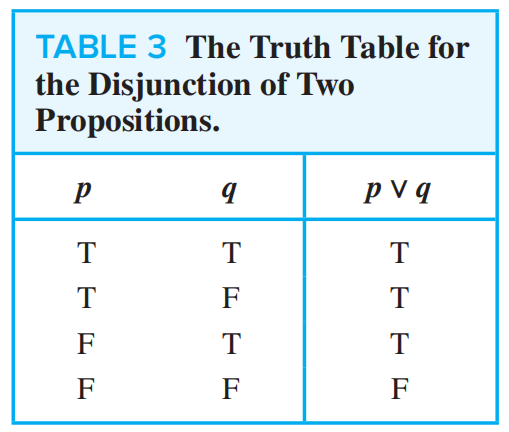
disjunction(inclusive or, 析取): \(p\vee q\).
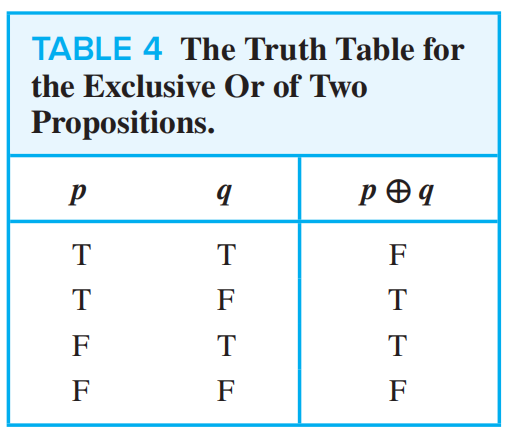
XOR(exclusive or, 异或): \(p\oplus q\).
Supplement
NOR(not or, 或非): \(p \downarrow q \equiv \neg(p \vee q)\).
NAND(not and, 与非): \(p \mid q \equiv \neg(p \wedge q)\).
conditional statement(implication, 蕴含): \(p\to q\) .
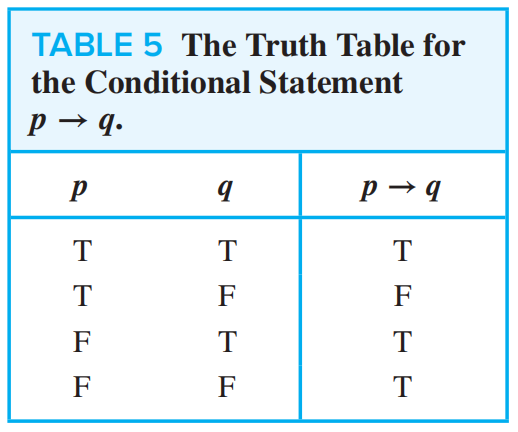
The statement p is called the hypothesis(假设), q is called the conclusion(结论).
Related Conditional Statements
- converse(逆命题): \(q\to p\)
- inverse(否命题): \(\neg p\to\neg q\)
- contrapositive(逆否命题): \(\neg q \to \neg p\)
Equivalent Forms in English
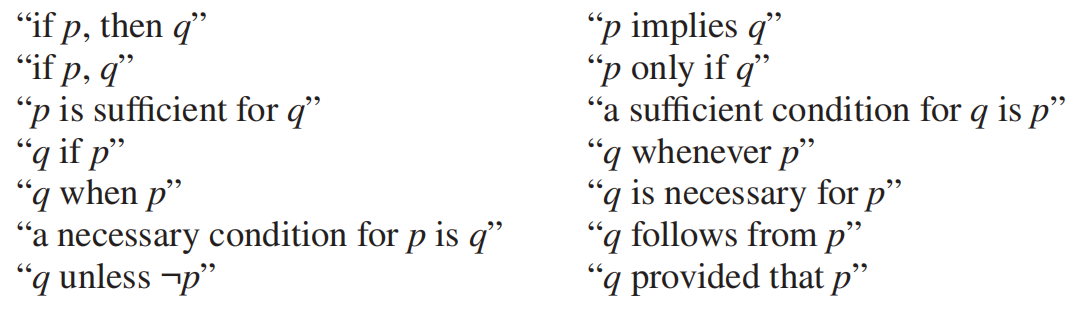
Implication Law: \(p\to q\equiv \neg p \vee q\)
PS: "\(q\) unless \(\neg p\)" is \(p\to q\), we can remember "unless" as \(\lor\), then "\(q\) unless \(\neg p\)" is \(q \lor \neg p \equiv p \to q\). And "\(p\) unless \(q\)" and "\(q\) unless \(p\)" are both \(p \lor q\).
biconditional(equivalence, 等价): \(p\leftrightarrow q\).
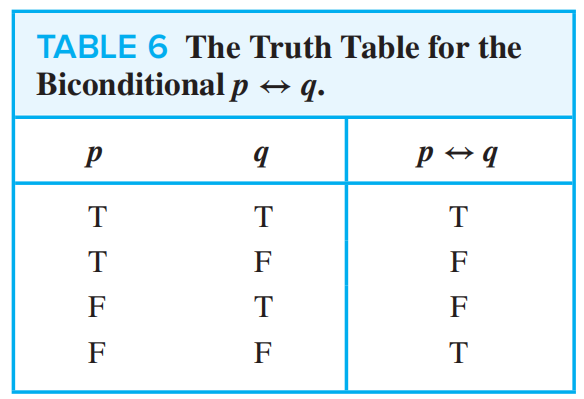
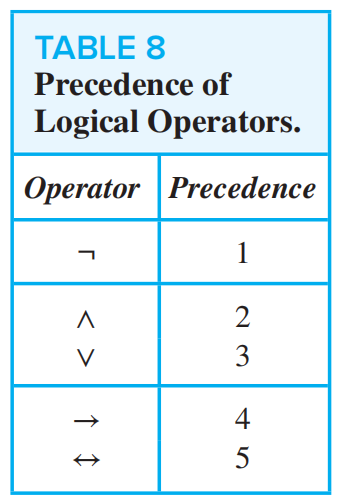
1.2.2 Precedence
1.2.3 Bit Expression
bit: A binary digit 0 (false) or 1 (true).
boolean variable: A variable whose value is either true or false. A boolean variable can be represented by a bit.
bit string: A sequence of bits. The length of bit string is the number of bits.
bit operations: Logical operations used on bits. Bitwise operations are bit operations used on strings with same length and operate for their every bit.
- bitwise OR
- bitwise AND
- bitwise XOR
2. Applications of Propositional Logic
2.1 Translating English Sentences
- Identify atomic propositions and represent using propositional variables.
- Determine appropriate logical connectives.
2.2 System Specifications
consistency: A list of proposition is consistent if it is possible to assign truth values to the proposition variables so that each proposition is true.
2.3 Logical Circuit
Propositional logic can be applied to the design of computer hardware.
Logic circuit or digital circuit receives input signals and produces output signals.

3. Propositional Equivalences
3.1 Logical Equivalences
tautology(永真式/重言式): A compound proposition that is always true.
contradiction(永假式/矛盾式): A compound proposition that is always false.
contingency(偶真式): A compound proposition that is neither a tautology nor a contradiction.
The compound propositions \(p\) and \(q\) are called logically equivalent if \(p\leftrightarrow q\) is a tautology, noted by \(p\equiv q\).
Important Logical Equivalences
Exclusive OR:
- \(p\oplus q\equiv(p\vee q)\wedge\neg(p \wedge q)\)
-
\(p\oplus q\equiv(p \wedge \neg q)\vee (\neg p\wedge q)\)
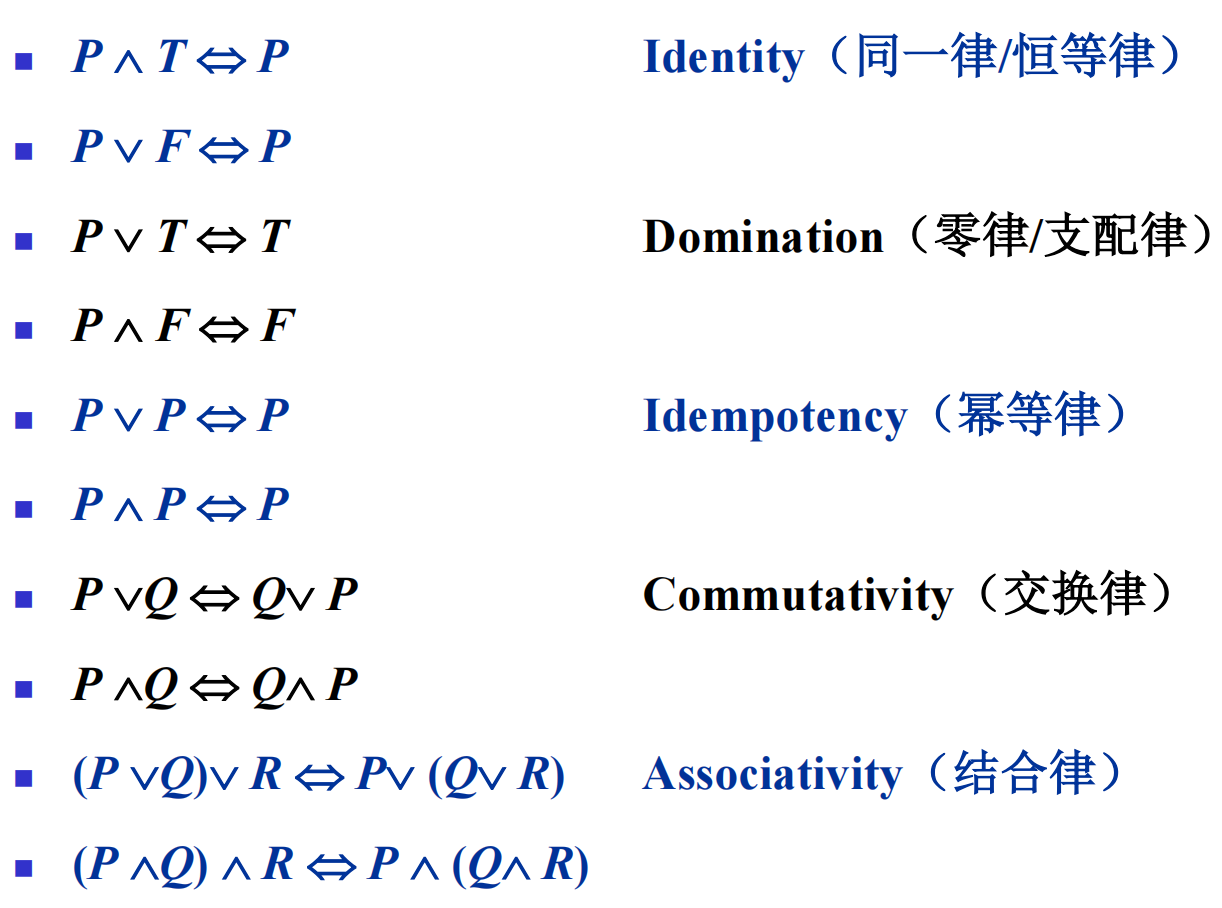
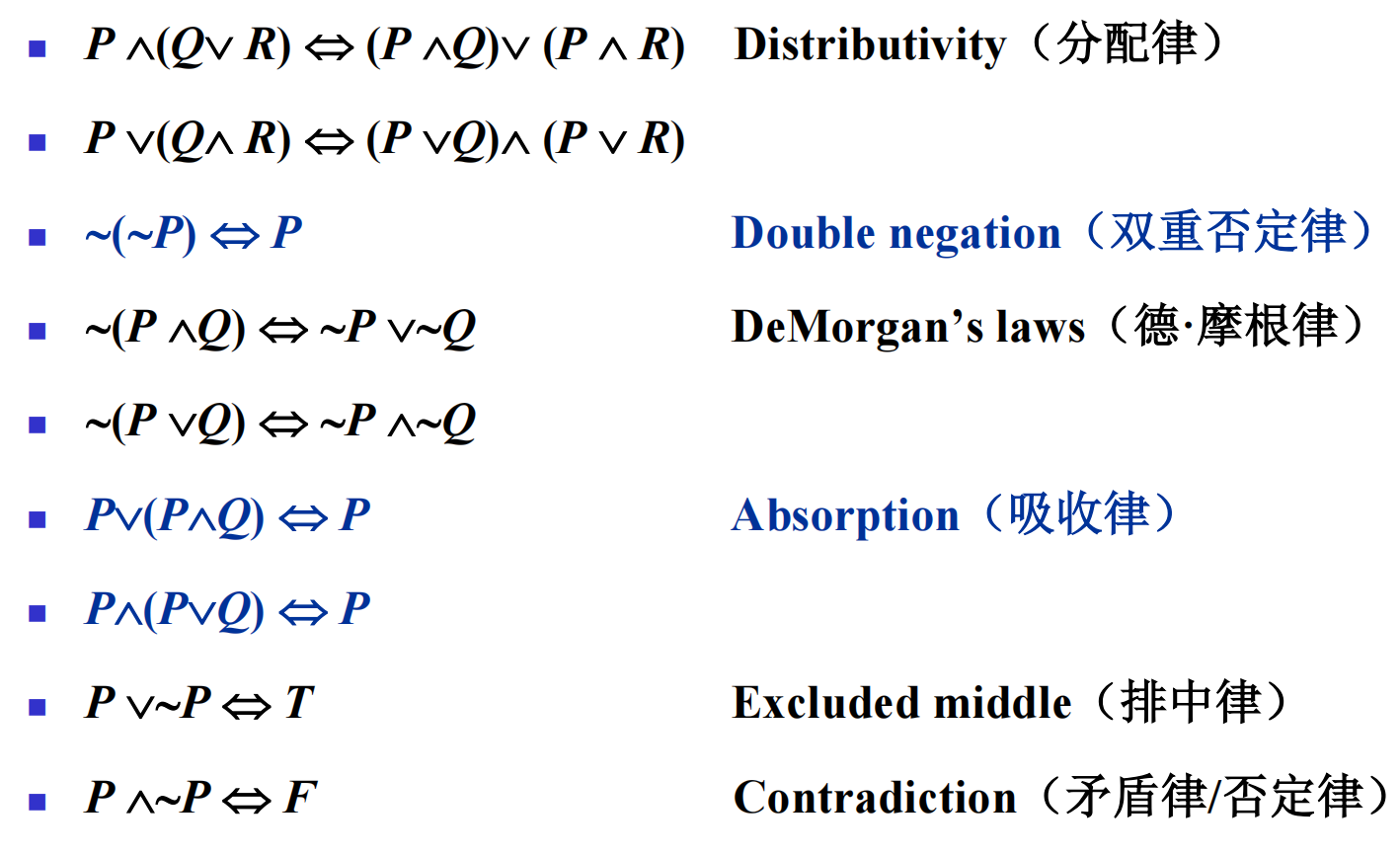
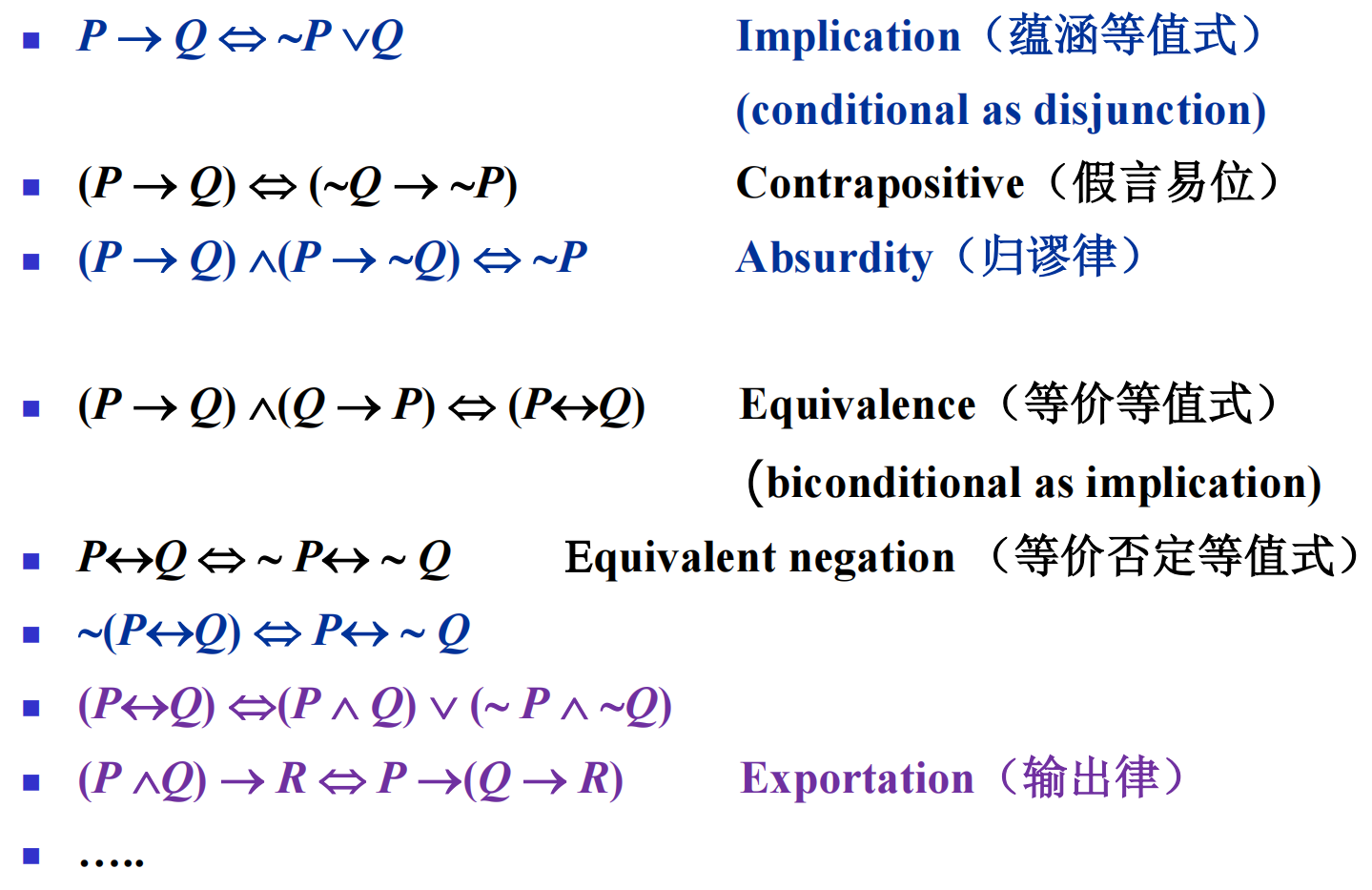
3.2 Using De Morgan’s Laws
De Morgan's Laws:
- \(\neg(p\wedge q)\equiv\neg p \vee \neg q\)
- \(\neg(p\vee q)\equiv\neg p \wedge \neg q\)
Extension:
- \(\neg(\bigvee_{i=1}^{n}p_{i})=\bigwedge_{i=1}^{n}\neg p_{i}\)
- \(\neg(\bigwedge_{i=1}^{n}p_{i})=\bigvee_{i=1}^{n}\neg p_{i}\)
3.3 Satisfiability
Satisfiability: A compound proposition is satisfiable if there is an assignment of truth values to its variables that makes it true (like consistency).
satisfiability = contingency + tautology
3.4 范式
简单析取式/基本和(simple disjunctive form/basic sum):仅由有限个命题变元或其否定的析取构成的析取式.
- \(\neg P \vee Q \vee R\), \(\neg P \vee P\).
简单合取式/基本积(simple conjunctive form/basic product):仅由有限个命题变元或其否定的合取构成的合取式.
- \(\neg Q \wedge R \wedge Q\), \(\neg P \wedge P\).
析取范式/DNF(Disjunctive Normal Form):由有限个简单合取式的析取构成的析取式.
- \(P\vee (P\wedge Q)\vee(\neg P\wedge \neg Q\wedge \neg R)\), \(P\vee Q\vee R\).
合取范式/CNF(Conjunctive Normal Form):由有限个简单析取式的合取构成的合取式.
- \((P \vee Q) \wedge \neg Q \wedge (Q \vee \neg R \vee S)\), \(P \wedge Q \wedge R\).
范式存在性定理
任意一个命题公式均存在与之等值的析取范式和合取范式.
证明(构造法):
- 利用蕴含等值式消去公式中的 \(\to\) 和 \(\leftrightarrow\):
- \(P\to Q \equiv \neg P \vee Q\).
- \(P\leftrightarrow Q \equiv (P\to Q)\wedge(Q \to P)\).
- 利用德摩根律将公式中的 \(\neg\) 移到命题变元之前,用双重否定律消去两个连续的 \(\neg\).
- 用分配律将公式化为基本积的析取(DNF)或基本和的合取(CNF).
- 为了得到DNF,将 \(\wedge\) 分配给 \(\vee\),使得最外层为 \(\vee\): \(P\wedge (Q \vee R)\equiv (P \wedge Q) \vee(P \wedge R)\).
- 为了得到CNF,将 \(\vee\) 分配给 \(\wedge\),使得最外层为 \(\wedge\): \(P\vee (Q \wedge R)\equiv (P \vee Q) \wedge(P \vee R)\).
问题在于,以这种方法得到的DNF/CNF不是唯一的.
3.4.1 主析取范式
极小项:\(n\) 个命题变项的极小项是这 \(n\) 个变元均出现一次的合取,并且保证每个变项或其否定二者仅出现一个.
例
公式中出现 \(P,Q,R\) 三个命题变项:
- \(P \wedge Q \wedge\neg R\) 是极小项.
- \(P \wedge Q\) 不是极小项,因为没出现 \(R\).
- \(P \wedge Q \wedge R \wedge \neg P\) 不是极小项,因为 \(P\) 出现两次.
对于每一个极小项 \(n\) 个变项的赋值中,只有一个赋值使其为真,其余 \(2^{n-1}\) 个赋值使其为假.
编码:若极小项对应赋值为 \(a_1a_2\cdots a_n\)(二进制数,为每一项的成真赋值),对应的十进制数为 \(k \in [0,2^n-1]\),记作 \(m_{a_1a_2\cdots a_n}\) 或 \(m_k\).
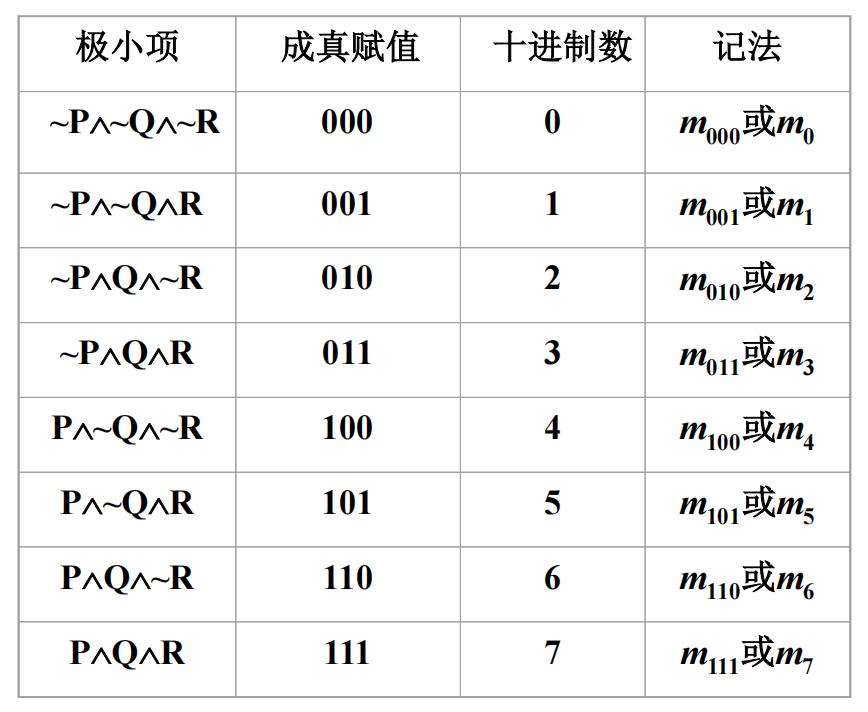
主析取范式(Principal DNF): 若干不同的极小项组成的析取式.
- \((P\wedge Q)\vee(\neg P \wedge R)\) 是析取范式,但不是主析取范式.
- \((P \wedge Q \wedge \neg R)\vee(\neg P \wedge Q \wedge R)\) 是主析取范式,并且也是析取范式.
定理
命题公式的主析取范式是由赋值为真对应的极小项的析取组成的.
任何一个命题公式均存在一个与之等值的主析取范式,而且是唯一的.
如何构造主析取范式?
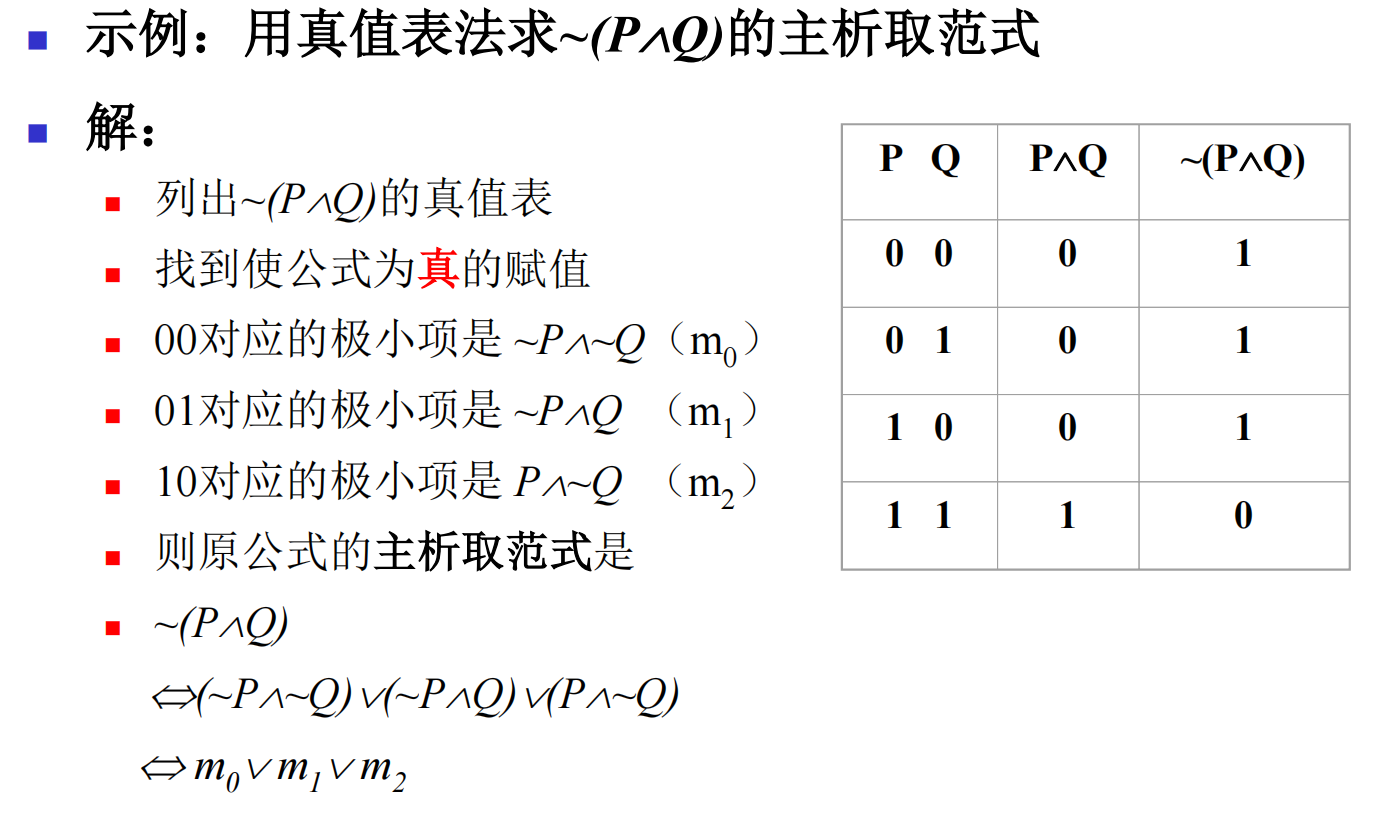
法一:真值表法
- 为命题公式构建真值表.
- 将每一个结果为真的行用极小项表示出来.
- 用析取连接极小项,即为主析取范式.
法二:等值演算法
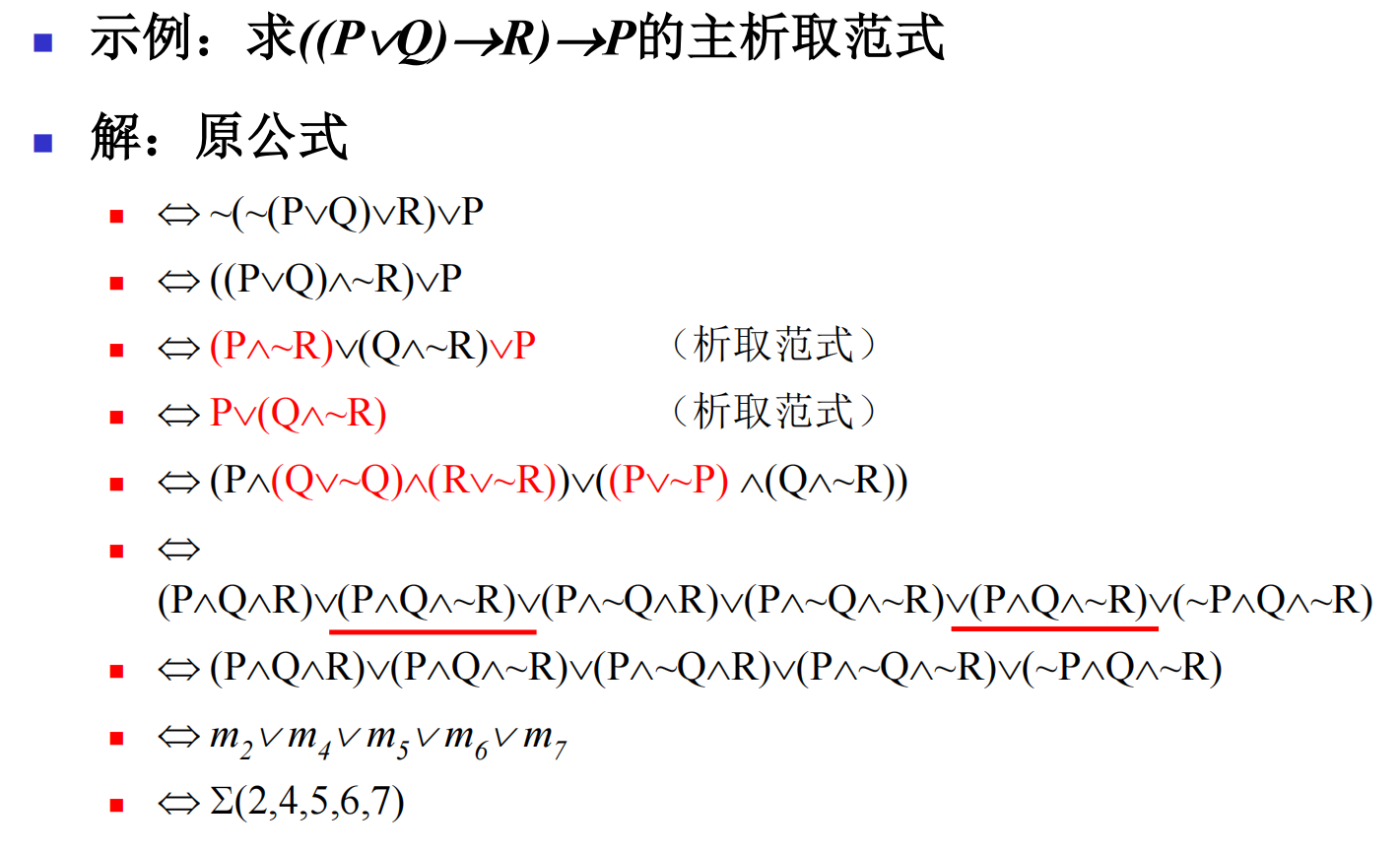
- 将公式化为析取范式,并将一些矛盾式、永真式、重复项消去.
- 若析取范式的简单合取式项缺少命题变项(如 \(R\)),添加一个永真式(\(R \vee \neg R\))然后用分配律打开.
- 用幂等律将重复的极小项删去(\(A \vee A \equiv A\)).
3.4.2 主合取范式
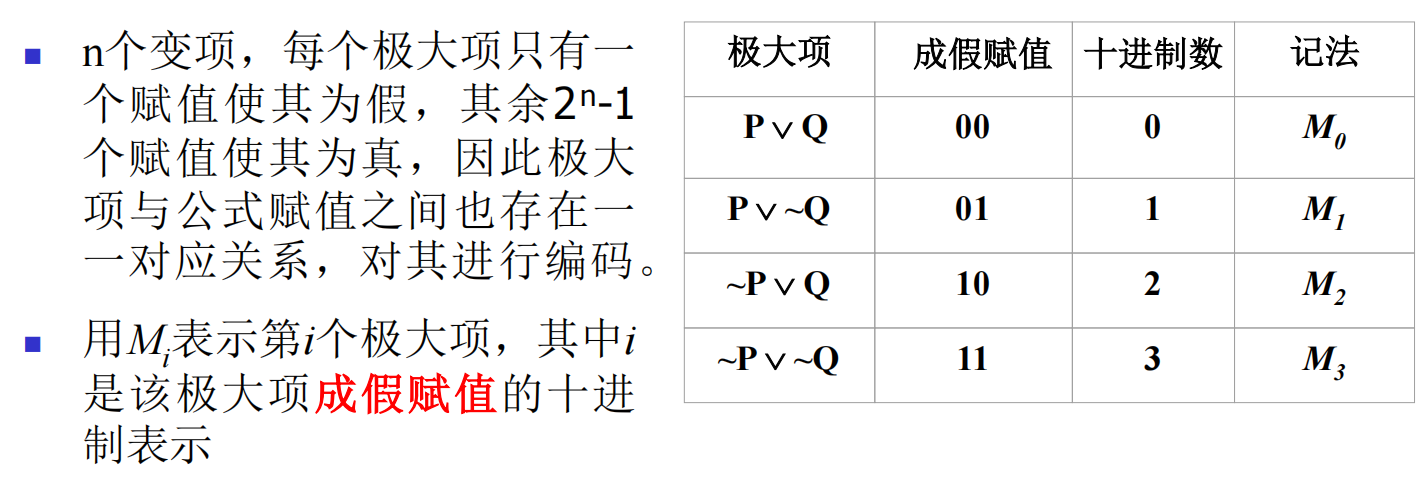
极大项:\(n\) 个命题变项的极大项是这 \(n\) 个变元均出现一次的析取,并且保证每个变项或其否定二者仅出现一个.
对于每一个极大项 \(n\) 个变项的赋值中,只有一个赋值使其为假,其余 \(2^{n-1}\) 个赋值使其为真.
编码:若极小项对应赋值为 \(a_1a_2\cdots a_n\)(二进制数,为每一项的成假赋值),对应的十进制数为 \(k \in [0,2^n-1]\),记作 \(M_{a_1a_2\cdots a_n}\) 或 \(M_k\).
主合取范式(Principal CNF):若干不同的极大项组成的合取式.
定理
命题公式的主合取范式是由赋值为假对应的极大项的合取组成的.
任何一个命题公式均存在一个与之等值的主合取范式,而且是唯一的.
如何构造 PCNF?
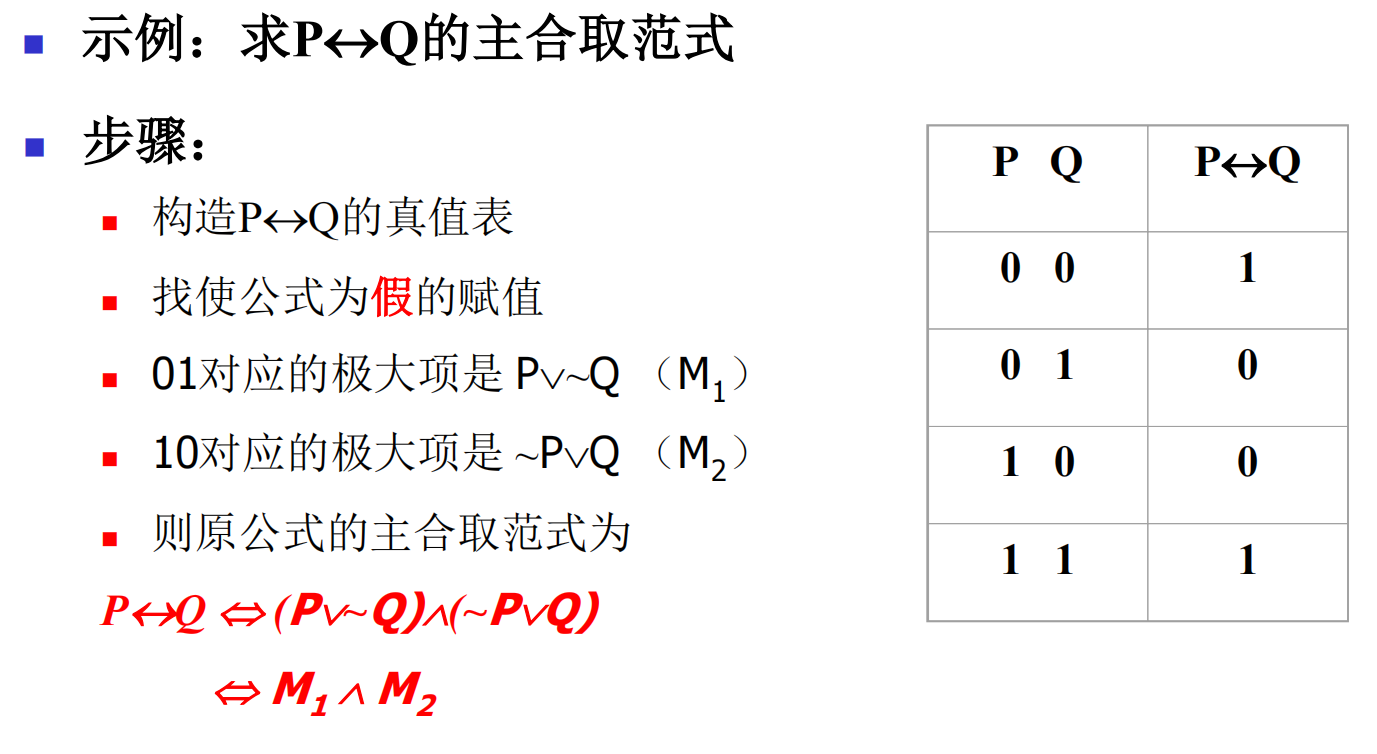
法一:真值表法
- 为命题公式构建真值表.
- 将每一个结果为假的行用极大项表示出来.
- 用合取连接极大项,即为主合取范式.
法二:等值演算法
- 将公式化为合取范式,并将一些矛盾式、永真式、重复项消去.
- 若合取范式的简单析取式项缺少命题变项(如 \(R\)),添加一个永假式(\(R \vee \neg R\))然后用分配律打开.
- 用幂等律将重复的极大项删去(\(A \vee A \equiv A\)).
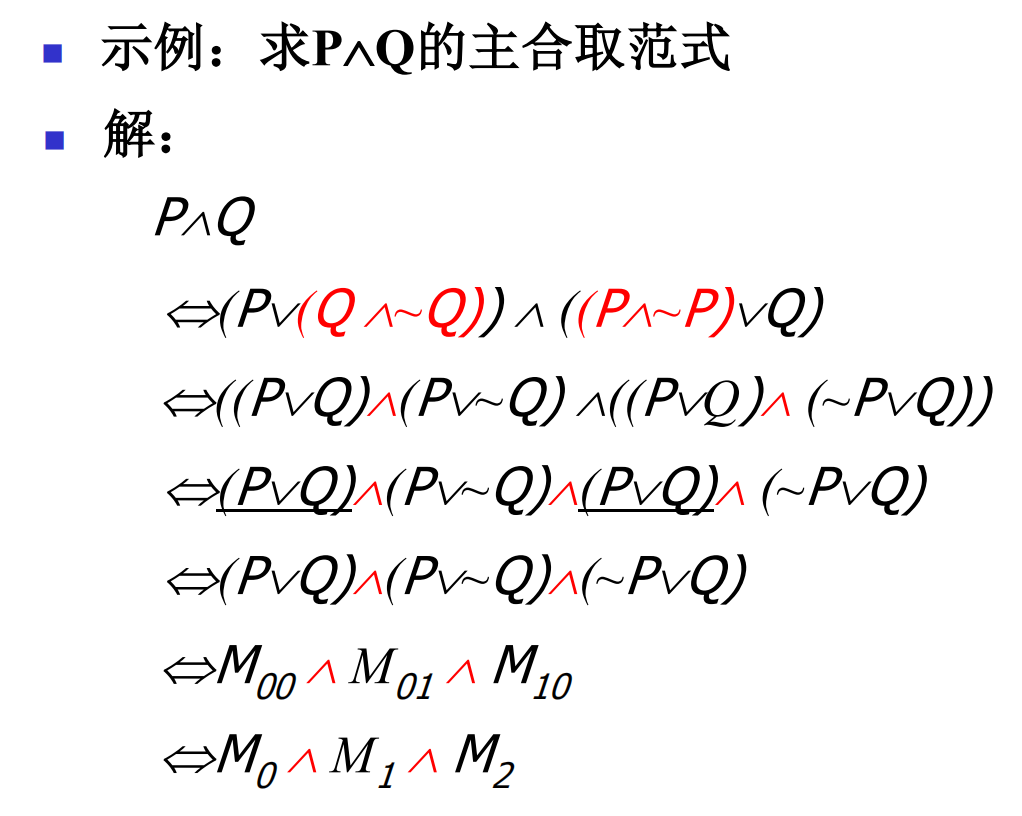
总结:主析取范式和主合取范式都是求一个命题公式等价形式的方法.
主析取范式是将该命题公式所有为真的取值全部凑出来(极小项,一个极小项对应一个为真的取值)并析取;如果我们的赋值是原命题公式的成真赋值,那么一定可以对应让某一个极小项为真,从而主析取范式为真.
主合取范式是将该命题公式所有为假的取值全部凑出来(极大项,一个极大项对应一个为假的取值)并合取;如果我们的赋值是原命题公式的成真赋值,那么它不会让任何一个极大项为假,从而主合取范式为真;反之如果是原命题的成假赋值,其一定会对应一个极大项为假,从而主合取范式为假.
因此,对于同一个命题,其主析取范式与主合取范式的下标总是互补的.
即
其中
例如三个命题变量 \(p,q,r\),若他们的主合取范式为 \(M_0\land M_4\land M_5\),则他们的主析取范式为 \(m_1\lor m_2\lor m_3\lor m_6\lor m_7\).
4. Predicates and Quantifiers
4.1 Predicates
predicate(谓词): Propositions which contain variables. When its variables bound by assigning it a value or an object from the domains of discourse(论域), predicates become propositions.
We can also regard predicate as propositional function. The result of applying a predicate \(P\) to a constant \(a\) is the proposition \(P(a)\), to a variable \(x\) is the proposition form \(P(x)\).
4.2 Quantifiers
universal quantifiers(全称量词): \(\forall\).
\(\forall xP(x)\) means: "For all \(x\), \(P(x)\)".
existential quantifiers(存在量词): \(\exists\).
\(\exists xP(x)\) means: "For some \(x\), \(P(x)\)".
uniqueness quantifiers(唯一存在量词): \(\exists!\).
\(\exists!xP(x)\) means: "There is one and only one \(x\) such that \(P(x)\)".
The uniqueness quantifier is not really need as it can be expressed with universal quantifiers and existential quantifiers:
\(\exists !xP(x)\equiv \exists x(P(x)\wedge \forall y(P(y)\to y=x))\).
And we will not use it since it's more difficult to simplify it than \(\exists\) and \(\forall\).
If the domain of discourse is null, then
- \(\forall xP(x)\) is a tautology, because we can't find a counterexample.
- \(\exists xP(x)\) is a contradiction, because we can't find any \(x\) that satisfies \(P(x)\).
4.2.1 Quantifiers over Finite Domains
- \(\forall xP(x)=\bigwedge_{i=1}^{n}P(i)\).
- \(\exists xP(x)=\bigvee_{i=1}^{n}P(i)\).
4.2.2 Quantifiers with Restricted Domains
-
Universal Quantifier:
-
Rule: For a universal quantifier, a restricted domain is expressed using implication(\(\to\)).
-
Example: \(\forall x \in S, P(x)\equiv\forall x (x \in S \to P(x))\).
-
-
Existential Quantifier:
-
Rule: For an existential quantifier, a restricted domain is expressed using conjunction (\(\wedge\)).
-
Example: \(\exists x \in S, P(x)\equiv\exists x (x \in S \wedge P(x))\).
-
4.3 Property of Quantifiers
4.3.1 Binding Variables
-
When a quantifier is used on the variable \(x\), we say that this occurrence of the variable is bound.
-
An occurrence of a variable that is not bound by a quantifier or set equal to a particular value is said to be free.
4.3.2 Nesting of Quantifiers
The order of different quantifiers cannot be changed arbitrarily.
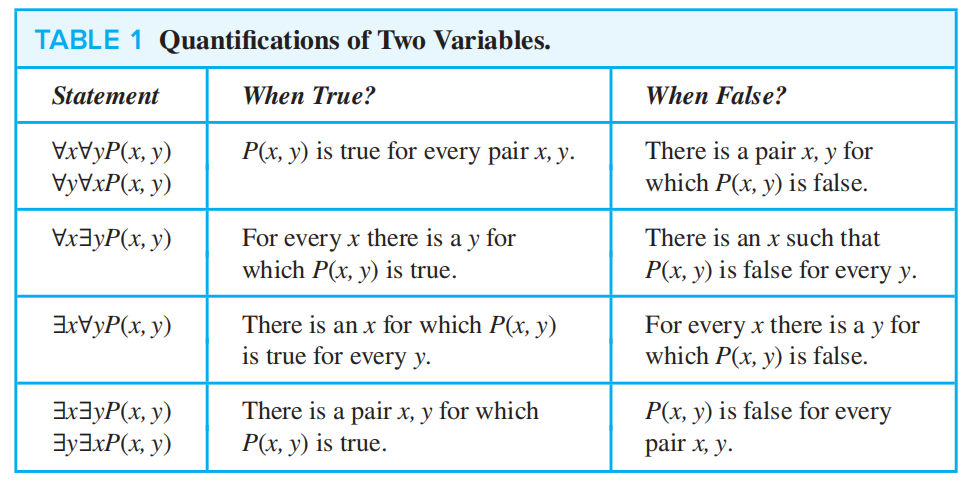
Example
Let \(P(x,y):y>x\).
- \(\forall x\exists yP(x,y)\): There isn't the biggest number.
- \(\exists y \forall xP(x,y)\): The biggest number exists. Changing the order of quantifiers completely changes the meaning of the proposition.
4.3.3 Logical Equivalences Involving Quantifiers
Statements involving predicates and quantifiers are logically equivalent iff they have the same truth value no matter which the predicates an the domain of discourse.
4.3.4 Negating Quantified Expressions
De Morgan's Laws for Quantifiers:
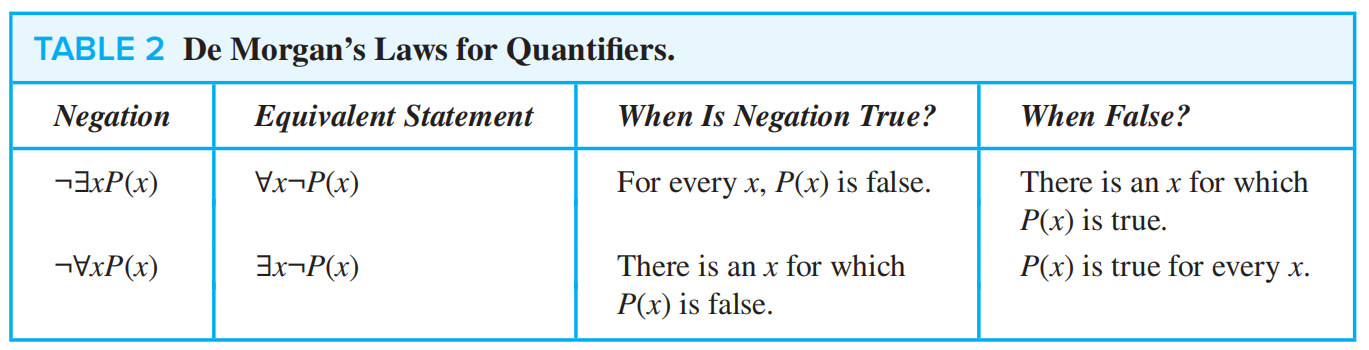
If there are more quantifiers, we can use De Morgan's Laws recursively:
4.3.5 Some Shorthands
- \(\exists x\exists y\exists z\,P(x,y,z) \leftrightarrow_{\text{def}}\exists xyz\,P(x,y,z)\).
- \(\forall x\forall y\forall z\,P(x,y,z) \leftrightarrow_{\text{def}}\forall xyz\,P(x,y,z)\).
4.4 一阶逻辑合式公式
4.4.1 相关概念
个体常项(Constant):表示具体的特定对象,一般用 \(a,b,c\) 表示.
个体变项(Variable):表示不确定的泛指对象,常与量词、谓词一起出现,一般用 \(x,y,z\) 表示.
项(Term):个体常项、个体变项,以及以项为自变量的函数.
原子公式(Atomic Formula):以项为自变量的谓词.
合式公式(Well-formed formula):原子公式,以及有限次利用原子公式和逻辑运算符(\(A\wedge B,A\vee B,A\to B\) 等)、量词与个体变项(\(\exists xA,\forall xA\) 等)规则形成的符号串.
4.4.2 量词辖域与变项
指导变项:紧跟在量词后的个体变项.
- \(\exists {\color{red}x}(F(x)\wedge\forall {\color{green}y}(G(y)\to H(x,y)))\).
量词辖域:在 \(\exists xA,\forall xA\) 中,\(A\) 是量词的辖域(也就是指导变项后紧跟的整个括号内的内容).
- \(\exists x{\color{red}F(x)}\wedge\forall y{\color{green}(G(y)\to H(x,y))}\).
- \(\exists x\color{red}(F(x)\wedge\forall y(G(y)\to H(x,y)))\).
约束出现:在辖域中与指导变项同名的变项.
- \(\exists {\color{red}x}(F({\color{red}x})\wedge\forall {\color{green}y}(G({\color{green}y})\to H({\color{red}x},{\color{green}y})))\).
自由出现:既非指导变项又非约束出现.
- \(\forall y(G(y)\to H({\color{blue}x},y))\).
闭式:无自由出现的变项.
- \(F(a),\exists xF(x)\) 是闭式.
- \(F(x),\forall y(G(y)\to H(x,y))\) 不是闭式.
4.5 一阶逻辑等值式
等值:\(A\Leftrightarrow B\).\(A\Leftrightarrow B\) 当且仅当 \(A\leftrightarrow B\) 是永真式.如 \(\neg\forall xF(x) \Leftrightarrow \exists x \neg F(x)\).
4.5.1 量词辖域收缩与扩张
放入括号的过程称为辖域扩张(scope expansion),提出括号的过程称为辖域收缩(scope contraction).
假设 \(B\) 中不含 \(x\) 的出现:
析取/合取式直接提出/放入括号,不需要改变符号.
- \(\forall x(A(x)\vee B)\Leftrightarrow \forall xA(x)\vee B\).
- \(\forall x(A(x)\wedge B)\Leftrightarrow \forall xA(x)\wedge B\).
- \(\exists x(A(x)\vee B)\Leftrightarrow \exists xA(x)\vee B\).
- \(\exists x(A(x)\wedge B)\Leftrightarrow \exists xA(x)\wedge B\).
可以推出结论:\(\forall xP(x)\wedge \exists yQ(y) \Leftrightarrow \forall x \exists y(P(x)\wedge Q(y))\).该结论对任意量词组合、合取析取均成立,也就是说合取析取式的原子命题变量如果无关,可以直接提出量词成为前束范式.事实上,由于换名规则,也可以推出 \(\forall xP(x)\wedge \exists xQ(x)\) 与上式等值.
蕴含式:若为前件则提出/放入括号时量词变号,若为后件则无需变号.
- \(\forall x(A(x)\to B)\Leftrightarrow \exists xA(x)\to B\).
- \(\forall x(B\to A(x))\Leftrightarrow B\to\forall x A(x)\).
- \(\exists x(A(x)\to B)\Leftrightarrow \forall xA(x)\to B\).
- \(\exists x(B\to A(x))\Leftrightarrow B\to\exists x A(x)\).
蕴含式的证明(以全称量词为例)
直观理解:对于所有 \(x\),只要有 \(A(x)\) 就有 \(B\),那么如果我存在一个满足 \(A(x)\) 的 \(x\),我就一定能推出 \(B\).
直观理解:对于所有 \(x\),如果 \(B\) 满足了,它们都会满足 \(A\),那么如果有条件 \(B\),必然有所有 \(x\) 都满足 \(A(x)\).
4.5.2 量词分配
全称量词对合取可分配,对析取单向推出:
- \(∀x(A(x)∧B(x))\Leftrightarrow ∀xA(x)∧∀xB(x)\)
- \(∀x(A(x)∨B(x))⇐∀xA(x)∨∀xB(x)\)
存在量词对析取可分配,对合取单向推出:
- \(∃x(A(x)∨B(x))≡∃xA(x)∨∃xB(x)\)
- \(∃x(A(x)∧B(x))⇒∃xA(x)∧∃xB(x)\)
蕴含式的量词分配:
- \(\forall xA(x)\to\exists xB(x) \Leftrightarrow \exists x(A(x)\to B(x))\).
- \(\exists xA(x)\to\forall xB(x)\Rightarrow \forall x(A(x)\to B(x))\).
- \(\forall x(A(x)\to B(x))\Rightarrow \forall xA(x)\to \forall xB(x)\).
- \(\forall x(A(x)\leftrightarrow B(x))\Rightarrow \forall xA(x)\leftrightarrow \forall xB(x)\).
4.5.3 换名规则
可以把某个指导变项和其量词辖域中所有同名的约束变项, 都换成新的个体变项符号;也可以把某个自由变项的所有出现, 都换成新的个体变项符号.
如:
- \(\forall xA(x)\wedge \forall xB(x)\Leftrightarrow \forall xA(x)\wedge \forall yB(y)\).
- \(\forall xA(x)\wedge B(x) \Leftrightarrow \forall xA(x)∧B(y)\)
4.5.4 前束范式
前束范式(Prenex Normal Form):量词均在合式公式的开头,且它们的辖域延伸到整个公式末尾.
存在性定理:谓词逻辑合式公式均存在与之等值的前束范式.合式公式的前束范式是不唯一的.
例
5. Rules of Inference
5.1 Valid Arguments in Propositional Logic
argument(论证): A sequence of statements.
conclusion(结论): The final statement of the argument.
premises(前提): Preceding statements of the argument except for the conclusion.
argument form(论证形式): A augument that propositions are replaced by propositional variables.
valid argument(合法论证): A argument that when all its premises are true, then the conclusion must also be true.
From the definition of a valid argument form we see that the argument form with premises \(p_1, p_2, …, p_n\) and conclusion \(q\) is valid exactly when \((p_1 ∧ p_2 ∧ ⋯ ∧ p_{n}) \to q\) is a tautology. We denote it by \(\Rightarrow\)(重言蕴含).
\(\to\) 与 \(\Rightarrow\) 的区别
\(\to\) 为逻辑联结词,\(A\to B\) 仍然是一个命题公式,其仍然有真假,当 \(A\) 为真 \(B\) 为假时为假.
\(\Rightarrow\) 为公式间的关系符,描述了两个公式间的关系,只能说 \(A\Rightarrow B\) 式整体成立或不成立.
\(A\Rightarrow B\) 成立的充要条件是 \(A\to B\) 为重言式.
5.2 Rules of Inference for Propositional Logic
We can establish the validity of some relatively simple argument forms, called rules of inference(推理规则). These rules of inference can be used as building blocks to construct more complicated valid argument forms.
modus ponens(假言推理规则)
modus tollens(拒取式)
The modus tollens is the contrapositive of modus ponens.
addition(析取引入规则)
conjunction(合取引入规则)
simplification(合取消去规则)
hypothetical syllogism(假言三段论)
disjunctive syllogism(析取三段论)
resolution(消解规则)
constructive dilemma(二难推论)
Another Expression
Using rules of inference also can be denoted by \(\vdash\).
For example:
- \(\{P\wedge Q ,P\}\vdash Q\)
- \(\{P\to Q, Q\to R\} \vdash \{P \to R\}\)
5.3 Using Rules of Inference to Build Arguments
formal proof: To prove an argument is valid or the conclusion follows logically from the hypotheses.
- Assume the hypotheses are true.
- Use the rules of inference and logical equivalences to determine that the conclusion is true.
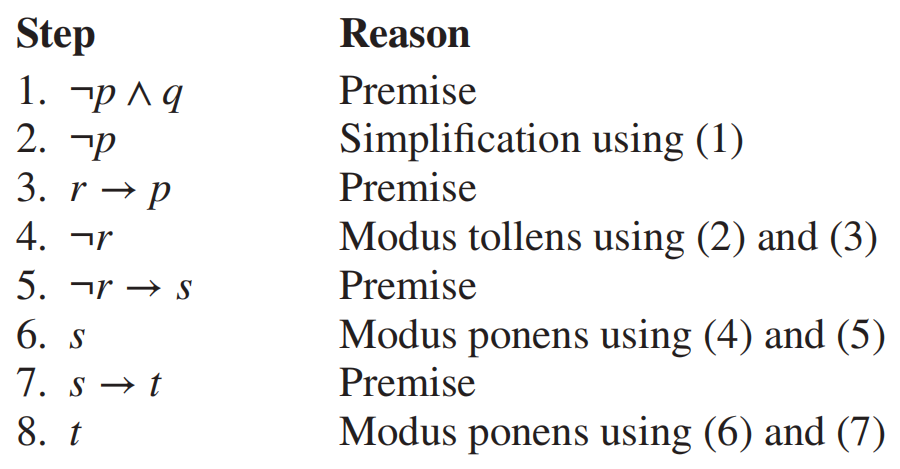
考试提醒 for BYR
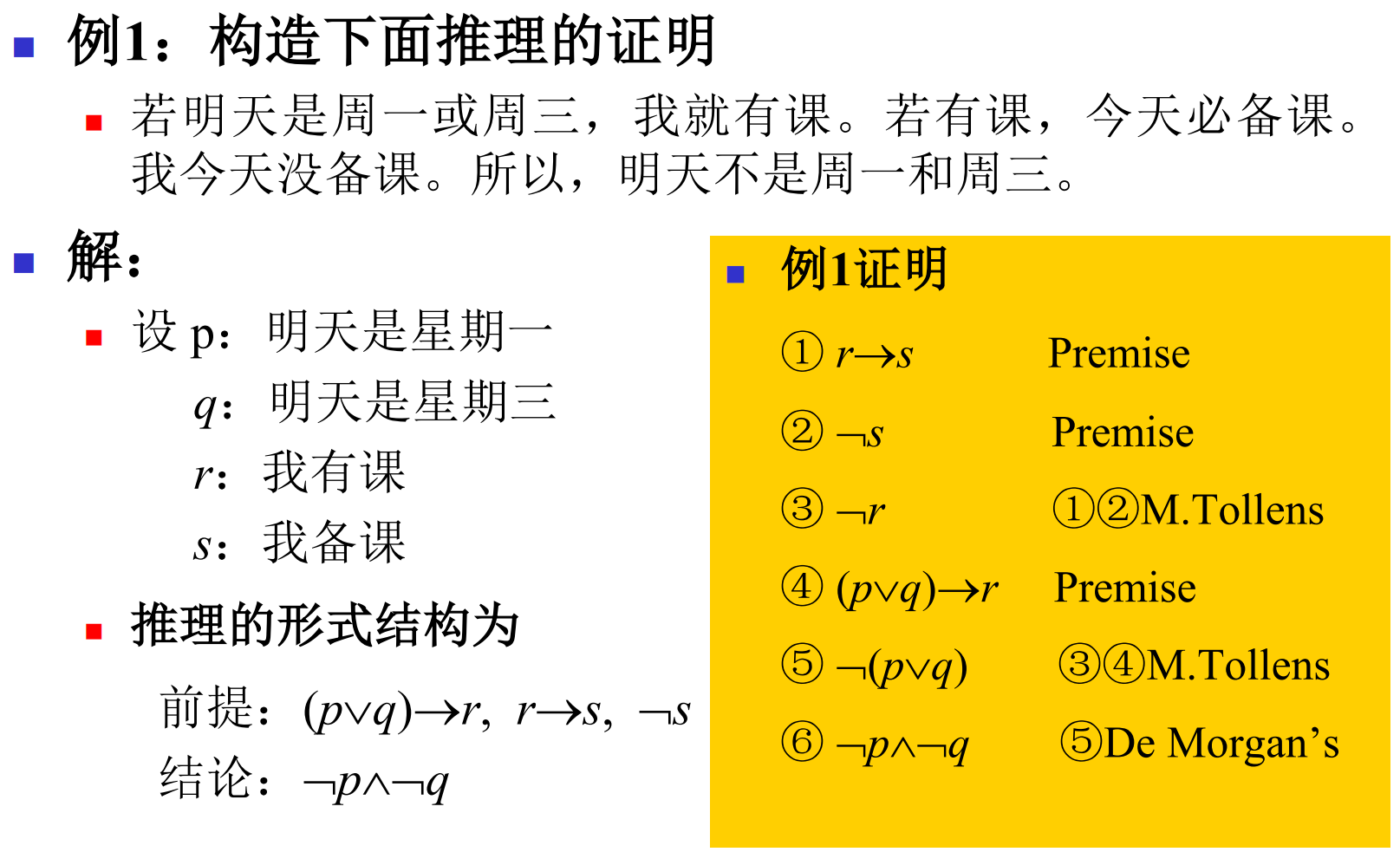
在做逻辑推理时要写三列(如图),分别是序号、命题、原因,这些都会计入考试给分.
5.4 谓词逻辑推理规则
5.4.1 代换实例
可以将公式代入命题逻辑规则,推理规则依然成立.
如将 \(P=F(a),Q=G(a)\) 代入假言推理规则,得到:
5.4.2 一阶逻辑等值式生成的推理规则
即由 \(A\Leftrightarrow B\) 可得 \(A\Rightarrow B\) 以及 \(B\Rightarrow A\).
如由 \(\forall x(A(x)\wedge B(x))\Leftrightarrow \forall xA(x)\wedge\forall xB(x)\),可得
5.4.3 一阶逻辑蕴含式生成的推理规则
如
5.4.4 一阶逻辑量词相关推理规则
UI/全称特例化(universal instantiation):由全称量词谓词得到任意自由变项或个体常项的公式.
UG/全称泛化(Universal Generalization):由自由变项公式得到全称量词公式.
EI/存在特例化(Existential Instantiation):由存在量词公式得到特定的个体常项公式.
EG/存在泛化(Existential Generalization):由个体常项公式推出存在量词公式.
注意事项
①:特例化时量词必须在最外层
只能对主逻辑运算符是 \(\forall\) 或 \(\exists\) 的公式使用EI/UI.在下面例子中,需要进行等值演算化简为前束范式.
- \(\neg \forall x P(x) \nRightarrow \neg P(c)\) 不能穿透否定符号.
- \(\exists x F(x) \rightarrow \forall y G(y)\) 不能各自剥离成为 \(F(c)\to G(z)\).
②:证明顺序
当使用一阶逻辑量词相关推理规则,一定要注意“先EI,后UI”,因为我们能保证EI特定的个体常项一定在UI的论域内从而符合对应公式,而不能保证UI选取的任意个体常项即为满足EI的特定个体常项.
如以前提 \(\forall x(F(x)\to G(x)),\exists xF(x)\) 证明结论 \(\exists xG(x)\),证明1正确而证明2错误.
证明1:
证明2:
5.5 构造证明
5.5.1 直接证明法
5.5.2 附加前提证明法
欲证明:
- 前提:\(A_{1},A_{2},\cdots,A_{k}\)
- 结论:\(C\to B\)
等价地证明:
- 前提:\(A_{1},A_{2},\cdots,A_{k},C\)
- 结论:\(B\)
证明
5.5.3 反证法
欲证明:
- 前提:\(A_{1},A_{2},\cdots,A_{k}\)
- 结论:\(B\)
方法:将 \(\neg B\) 加入前提,若推出矛盾,则得证结论正确.
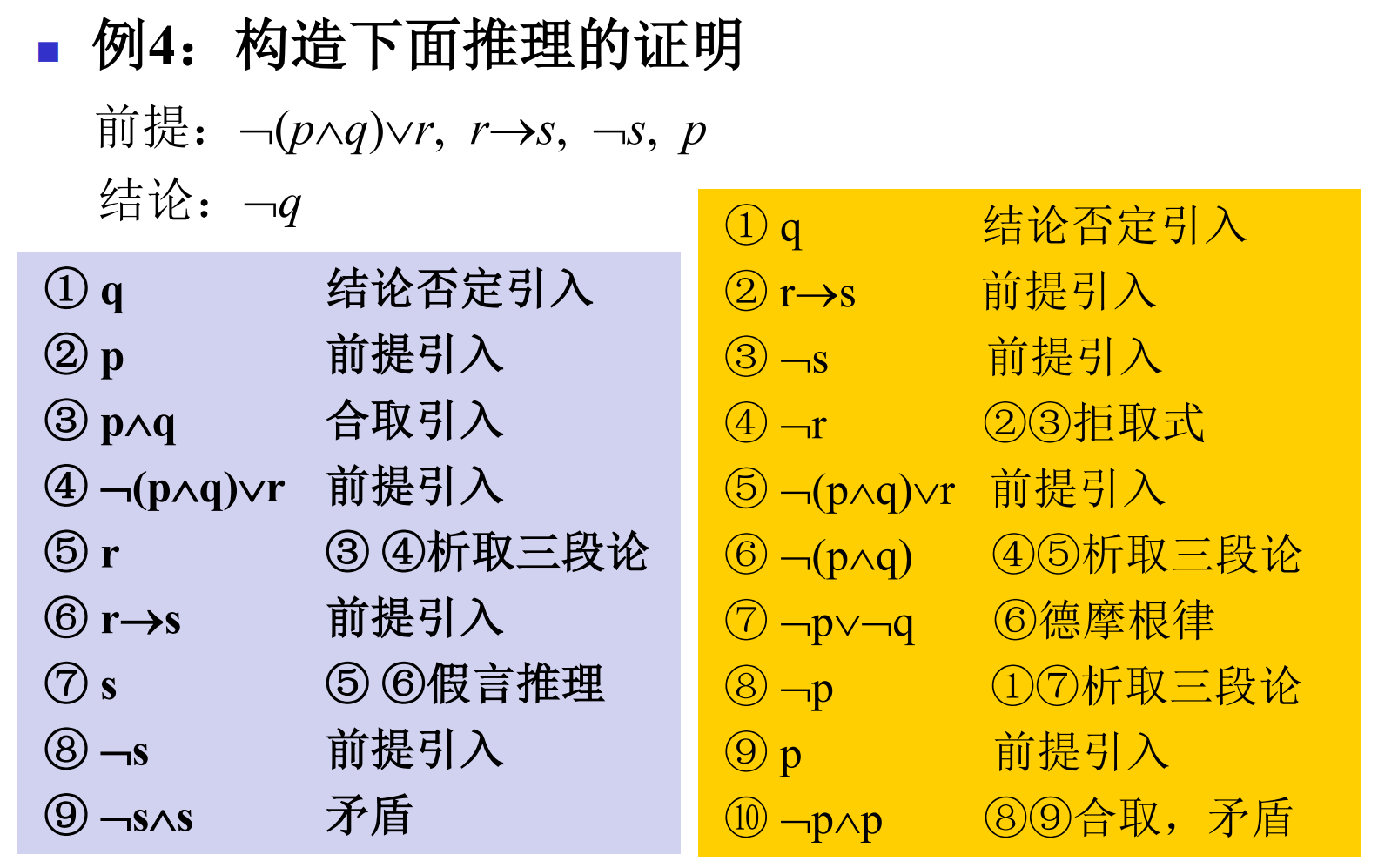
证明
原命题为重言式,当且仅当 \(A_{1}\wedge A_{2}\wedge \cdots \wedge A_{k}\wedge \neg B\) 为矛盾式.
注意事项
①:记得UI/EI只能作用于前束范式.
②:当要证明的蕴含式前后件被一个量词绑定时(即为前束范式时)不能使用附加前提证明法;而前后件被不同量词绑定时可以.
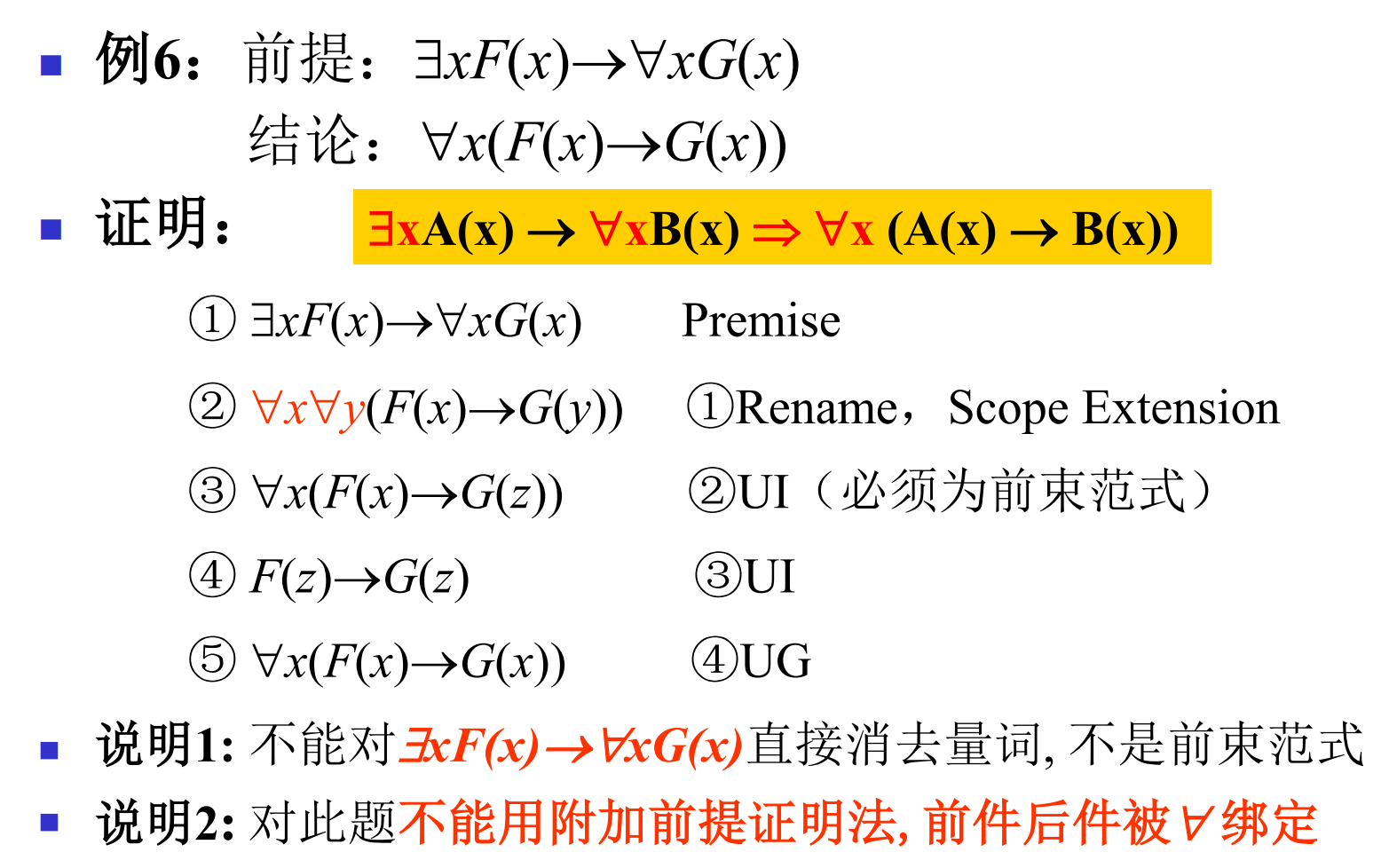
例6中,我们可以化简为前束范式得到 \(F(z)\to G(z)\),但不能直接由前提得到 \(F(z)\to G(z)\) .
同时由于前后件被 \(\forall x\) 绑定,不能使用附加前提证明.
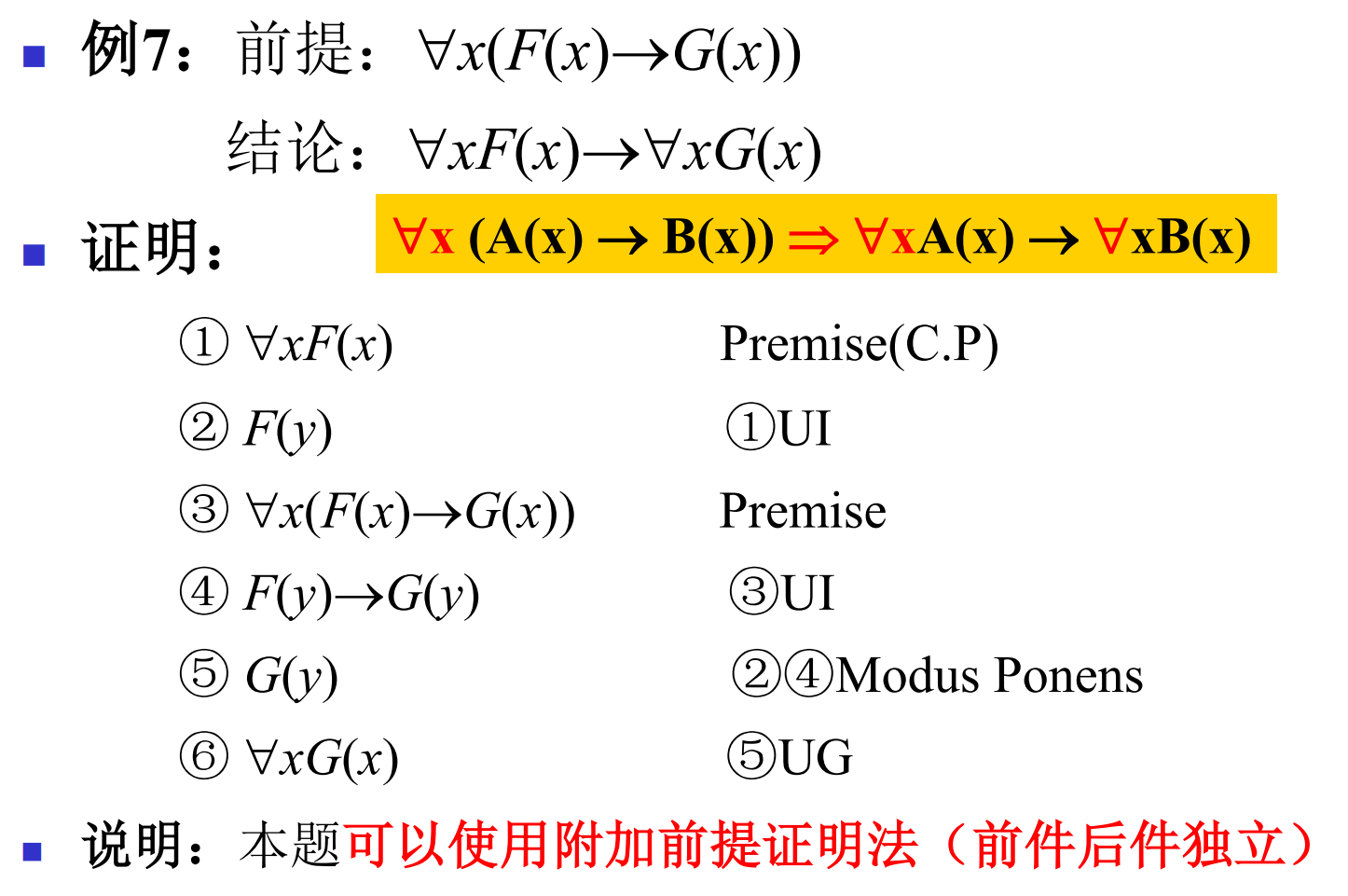
例7中,\(\forall xA(x)\) 与 \(\forall xB(x)\) 分开,可以使用附加前提证明.
6. Introduction to Proofs
Unlike the previous section on Formal Proof, which demands a machine-checked chain of strict inference rules, this section explores Informal Proof, where we care contents as well as forms.
6.1 Basic Terminology
theorem(定理): A valid logical assertion which can be proved using other theorems, axioms(公理), or rules of inferences.
lemma(引理): A pre-theorem that is helpful in the proof of other results.
corollary(推论): A theorem that can be established directly from a theorem that has been proved.
conjecture(猜想): A statement that is being proposed to be a true statement.
6.2 Proof Methods for Implications
Assume that we need to prove implication \(p\to q\).
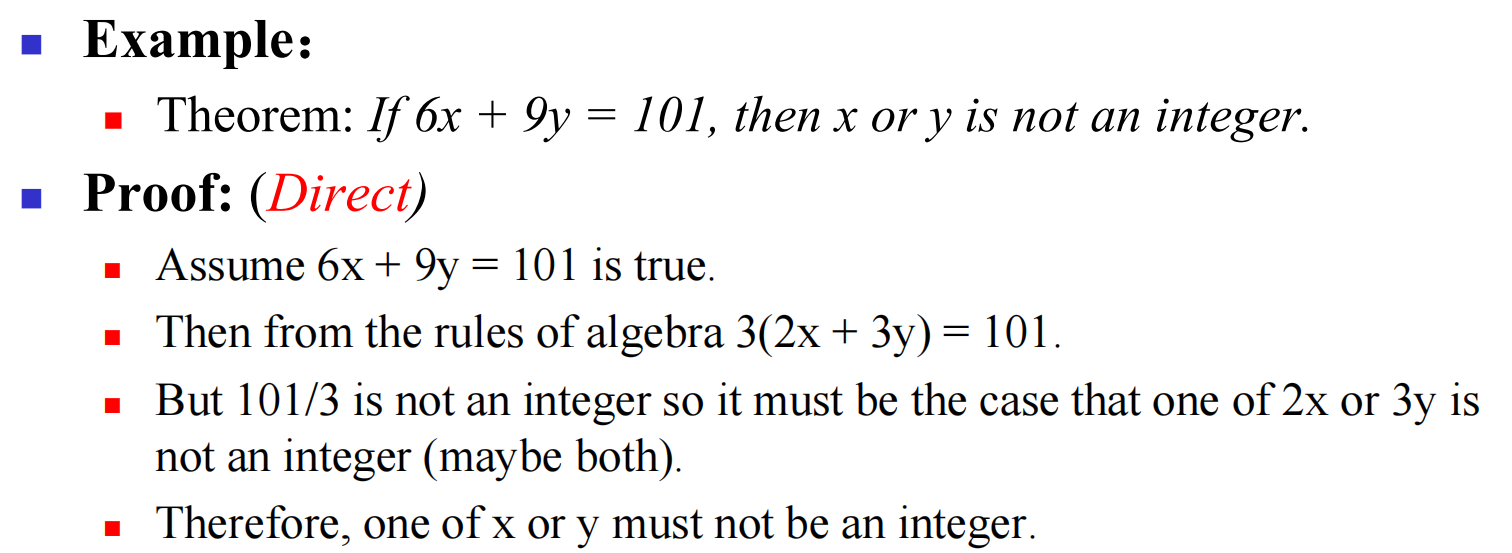
Direct Proof: Assume the premise \(p\) is true, and use rules of inference to prove conclusion \(q\).
example
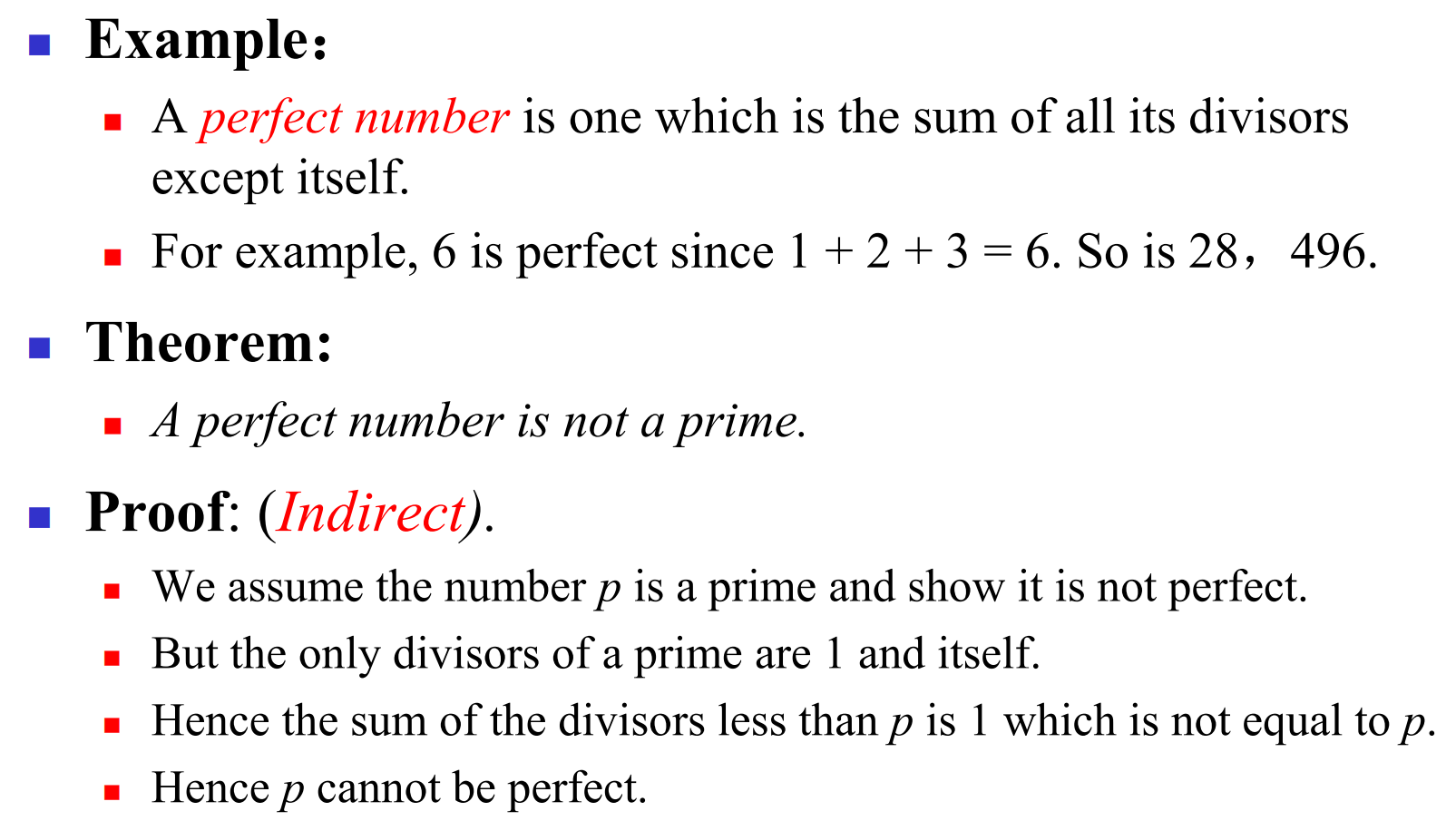
Indirect proof (Contrapositive): Assume the conclusion is false (\(¬q\) is true), and prove the premise is false (\(¬p\)).
example
Trivial proof(平凡证明): Prove \(q\) by itself; the assertion is trivially true independent of the truth of \(p\).
Vacuous proof(空证明): Prove \(¬p\) by itself; if the hypothesis \(p\) is false, then \(p→q\) is vacuously true.
Proof by contradiction(反证法): To prove a statement \(p\) is true, assume \(p\) is false and derive a contradiction.
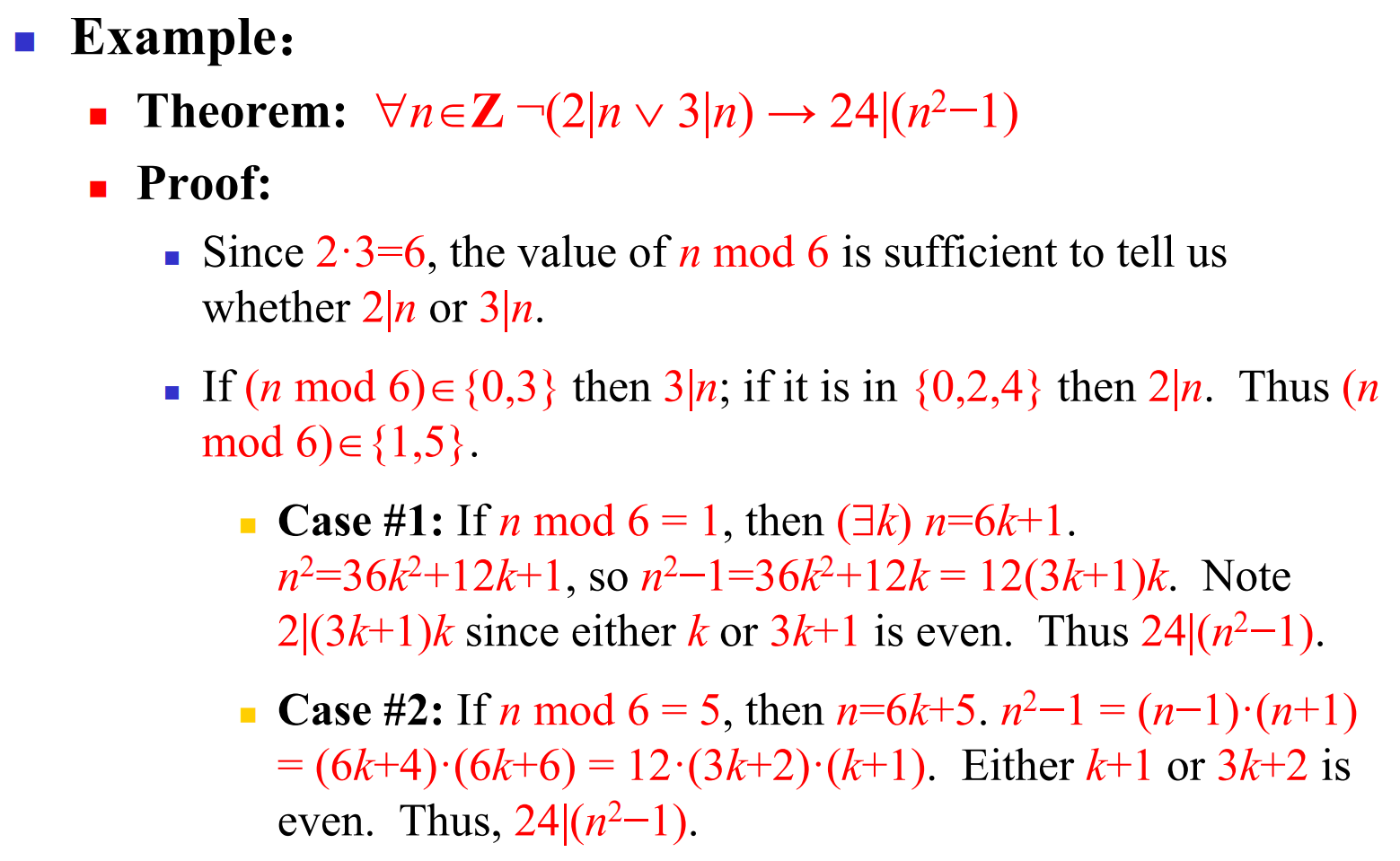
Proof by cases(分情况讨论): Break the premise into an equivalent disjunction (\(p_{1}∨p_{2}⋯∨p_{n}\)) and establish all implications \((p_{1}→q)∧⋯∧(p_{n}→q)\).
Example
warning
Proof by Cases must prove for all cases. If we don't cover all cases, then the proof is invalid.
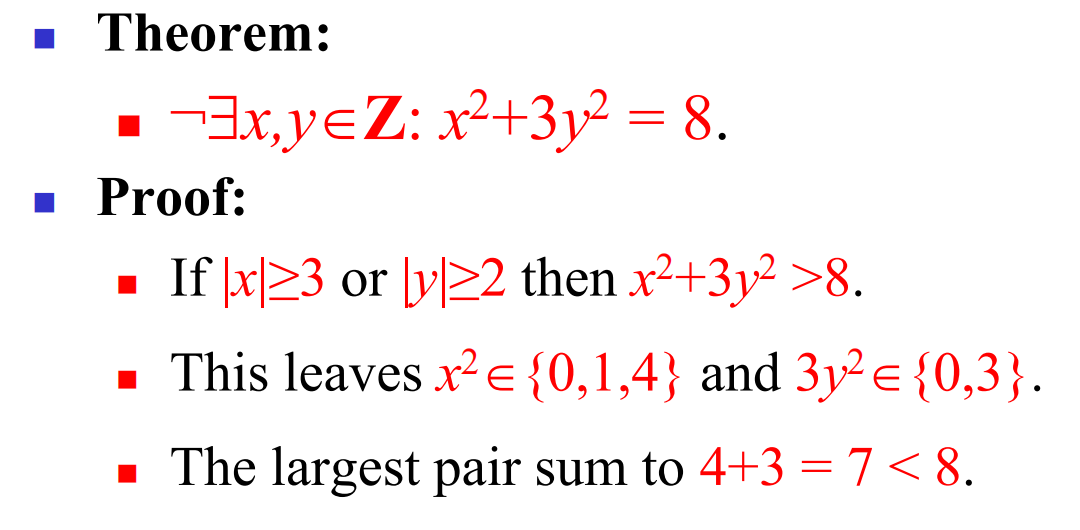
Exhaustive Proof(穷举法): A specific type of proof by cases where you exhaust all possible instances.
Example
Differences between Proof by cases and Exhaustive Proof
Exhaustive Proof is a specific variation of Proof by cases where you literally verify the theorem by exhausting all individual instances rather than dividing them into some cases. When the domain is infinite, we can't use Exhaustive Proof.
Without loss of generality (WLOG)(不失一般性): Used when covering one case is sufficient because other cases are similar and can be proven using the exact same logic.
Mathematical Induction
Not included in the textbook and the slides, but a good way to prove theorem of natural numbers. See Chap5.
6.3 Proof Methods for Quantified Statements
6.3.1 Existence Proofs
Assume that we need to prove \(\exists xP(x)\).
Constructive: Establish \(P(c)\) is true for some specific element \(c\) in the universe.
Example
Theorem: For any integer \(n>0\), there exists a sequence of \(n\) consecutive composite integers.
Proof: The same statement in predicate logic is
Construct \(x=(n+1)!+1\). Then \(x+i=(n+1)!+i+1\). Because \(1\leq i \leq n\), then \(2 \leq i + 1\leq n+1\), so
and
\(x+i\) is a composite integer for \(1\leq i \leq n\).
Nonconstructive: Assume no \(c\) exists which makes \(P(c)\) true and derive a contradiction, or show that an element must exist without explicitly describing it.
Example
Theorem1: There exist irrational numbers \(x\) and \(y\) such that \(x^y\) is rational.
Proof: Let \(x=\sqrt{2}\) and \(y=\sqrt{2}\). Make the following two cases:
- \(a\). \(\sqrt{2}^{\sqrt{2}}\) is rational.
- \(b\). \(\sqrt{2}^{\sqrt{2}}\) is irrational.
Because \(a\lor b\) is a tautology, exactly one of them must be true.
- If \(a\) is true, this immediately yields our claim, since \(x\) and \(y\) are both irrational and \(x^y\) is rational.
- If \(b\) is true, now we have a new irrational number \(\sqrt{2}^{\sqrt{2}}\). Let \(\sqrt{2}^{\sqrt{2}}\) and \(y=\sqrt{2}\), Then,
Now we again started with two irrational numbers \(x\) and \(y\) and obtained rational \(x^y\).
Theorem2: There are infinitely many prime numbers.
Proof: Any finite set of numbers must contain a maximal element, so we can prove the theorem if we can just prime number. I.e., proof that for any prime number, there is a larger number that is also prime.
\(\forall\) Prime \(n\), consider \(x=n!+1\).
- If \(x\) is a prime integer, since \(x>n\), then the theorem is true.
- If \(x\) is a composite integer, then it must have a prime factor \(p\), i.e. \(x\equiv 0\pmod{p}\). But if \(p\leq n\), then \(x\equiv 1\pmod{p}\) because \(x=n!+1\). So \(p>n\). And \(p\) is a prime number, so the theorem is true.
6.3.2 Nonexistence Proofs
Nonexistence Proofs \(\neg\exists xP(x)\) is equivalent to proving \(\forall x\neg P(x)\). Then is a problem for Universal Proofs.
6.3.3 Universal Proofs
To proof \(\forall xP(x)\), assume \(x\) is an arbitrary member of the universe and show \(P(x)\) must be true, then use UG.
6.3.4 Nonuniversal Proofs
Nonuniversal Proofs \(\neg\forall xP(x)\) is equivalent to proving \(\exists x\neg P(x)\). Then is a problem for Existence Proofs. We need to construct a counterpart.
6.3.5 Uniqueness Proofs
Uniqueness Proofs consists of two steps.
- show existence (\(∃xP(x)\)).
- show uniqueness by proving \(∀y(P(y)→y=x)\) or \(∀y(y\neq x→¬P(y))\).
6.4 Some Fallacies
Some fallacies(谬论) may occur when we are proving:
Fallacy of Affirming the Consequent: \(P\to Q,Q\), so \(P\). I.e. \({\color{red}[(P\to Q)\wedge Q]\to P}\).
Fallacy of Denying the Antecedent: \(P\to Q,\neg P\), so \(\neg Q\). I.e. \({\color{red}[(P\to Q)\wedge \neg P]\to \neg Q}\).
Circular Reasoning: The fallacy of explicitly or implicitly assuming the very statement you are trying to prove within the proof itself.